
Dobro veče, Salut, Hi

French-Canadian who married a girl from Belgrade, has travelled extensively throughout Serbia, makes domaća kafa in
his džezva every morning, boasts an impressive cache of village rakija, and sings starogradske pesme in the shower. He’s
nuts alright, but most experts believe he’s harmless and might even be beneficial… if taken in small doses.
This is what I hear when I enter the side door of Montreal’s Saint Sava Holy Trinity Serbian Orthodox Church and head down the stairs to the community room, as I do every Friday evening. My son has already skipped along, hung his coat, changed his boots to opanci, and melded with the other kids buzzing about before the dance teacher calls them to order.
Ahead of this, I hear the kids taunting each other to play tag and comparing notes about Pokemon card collections, Clash Royale scores, and hockey stats. This all happens in a hodge-podge of Canada’s two official languages: the educational language laws in Quebec mean that most of our kids have to get their primary and secondary educations in French, while their media (the music and films they absorb) favours English.
Our kids are like linguistic sponges, I have heard people say, and this is tested to truth every day in a city like Montreal. Such is our diversity that we have every cultural group Toronto and Vancouver has, plus Franco-Europeans (Belgians, French, and Swiss), Franco-Arabs and Maghrebins (Lebanese, Algerians, Tunisians and Moroccans), and Franco-sub-Saharan-Africans (Malians, Cameroons, Congolese, Rwandans, Ugandans, Senegalese, Ivorians, Burkina Faso's, and Beninese). And if that doesn’t impress you, I should add that I once met a fellow from Nepal. Well, you get my point: we’ve got just about every culture on Earth in our city, and so it shouldn’t surprise us that our kids are a-ok with bilingualism.
But once the dance lesson begins, it is exclusively in the Serbian language. Some dances require singing, and half of the dancers are also in a children’s choir. For most of our kids these are the only occasions, outside of their home life, that they have to deal with others in a Slavic tongue. We have a modest Serbian school that operates on Sundays, but this is mostly for beginners and young children: a community this small has a hard time justifying a more elaborate curriculum. For our children to learn Serbian, we rely mostly on our domestic contexts (speaking Serbian at home), more than would Serbs in Toronto or Chicago or New York, communities whose cultural institutions are much larger and can offer more than ours ever will. Other than that, we only really have each other. Samo sloga Srbina spašava!
The Serbian spoken at folklore classes is also quite basic, but this has the advantage of being easier to follow, even by
my son who does not benefit from hearing Serbian at home. English is our family’s main language, despite my own best
efforts to try to learn a Slavic tongue. In my case, I was raised in English and work in French, and I struggle with a Serbian
grammar and syntax which requires me to reverse things in my head before trying to say them... nije lak za stranci kao
ja! It has been a challenge for my wife and I to motivate our son to want to learn Serbian. But while we assess that enterprise
negatively, we notice that he has no trouble following his dance teacher’s instructions, and he enjoys our frequent
immersive travels to Serbia. To hear our children slip in and out of not two, but three languages… well, we are all the
richer as a city in this world to have that possibility as a concrete reality. Recent research suggests that actively speaking
two or more languages regularly will ward off dementia in the future, so being Serbian in Montreal provides health benefits!
Neuro-linguistic super-food!
However, we are conscious that all of this is not enough, that our community’s children will likely not be teaching the Serbian language to their children, and that the reality of adapting to North America means that preserving the language and culture of the Serbs cannot be achieved outside the home without considerable effort.
There will always be a hundred more pressing priorities. For my own part, as a parent with a keen interest in my wife and child’s heritage, I try to promote all things Serbian in other ways. We keep our family aligned with the Julian calendar and celebrate
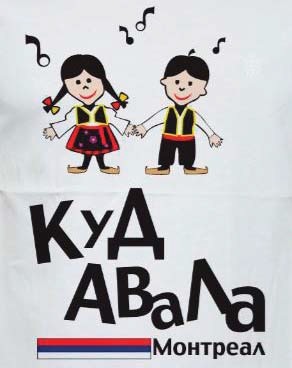
Serbian Orthodox Christmas, Easter and various Slavas. I explain much of the difficult Serbian past to my son so he gains a greater understanding of what Serbia means in terms of history, culture, language, and modern reality. On Remembrance Day, we revisit not only Canadian sacrifice, but also the Serbian experience of both world wars and the more recent conflicts. We travel to Serbia every year to tour a different region and discover local history, environment, and culture. We participate in outings with other Serbian families in order to foster and celebrate the shared Yugoslav heritage. We do what we can, because we know that without our efforts much of our shared Serbian culture would be lost to our children. They need to understand from where and through what their parents have come if they are to chart a clear course into their futures with the certainty that what came before is connected to what comes next. Thankfully, we have a društvo, named KUD Avala, in Montreal that allows us to do all of that! Slavas with Orthodox rites, parties with kolo dances, lots of occasions to meet old friends, have a drink, eat sarma and gibanica... while our children get to show off their folklore dance knowledge to wistful nostalgics.
With all of that, we hope our kids will know what to tell people who ask, “Are you Russian?”
КАЛЕНДАР КУЛТУРНИХ ДЕШАВАЊА
КАТЕГОРИЈЕ ЧЛАНАКА
- ДНЕВНИК ИМИГРАНТА
- ИЗДВАЈАМО
- ПИСМО УРЕДНИЦЕ
- АКТУЕЛНО
- ИНТЕРВЈУ
- ИНТЕРВЈУ: НА КАФИ
- КАНАДА
- СРПСКА ЗАЈЕДНИЦА
- СРБИ У СВЕТУ
- ЗАВИЧАЈ
- ПОСЕТИТЕ СРБИЈУ
- ЖИВОТ ДАНАС
- ИСТОРИЈА И ТРАДИЦИЈА
- КРОЗ ПРИЗМУ
- БИЗНИС, КАРИЈЕРА И ФИНАНСИЈЕ
- НОВЕ ДЕСТИНАЦИЈЕ
- УМЕТНОСТ И КУЛТУРА
- НЕГОВАЊЕ СРПСКОГ ЈЕЗИКА
- АЗБУКА ЗДРАВЉА
- ИЗ НАШЕ КУХИЊЕ
- ДНЕВНИК СРБОФИЛА
- СПОРТ И ХОБИ
- МЛАДИ НОВИНАРИ
- ДЕЧЈА СТРАНА
- НАШИ МЛАДИ
АКЦИЈА ПРИКУПЉАЊА НОВЧАНИХ ПРИЛОГА ЗА САН
Донацијом ћете помоћи да часопис настави да излази као и за одржавање веб-сајта. Ваше име или назив ваше фирме ће бити објављено на страници Наши спонзори, а уколико то не желите ваша донација ће остати анонимна (обратите пажњу да у апликацији одговорите да желите да донирате анонимно).
Хвала унапред.