
THE SHELL FOR UN/SHELTERED TORONTO
The City of Toronto provides extensive shelter services for individuals experiencing homelessness, offering temporary accommodation and support such as meals, laundry facilities, harm reduction programs, and mental and physical health care. Despite operating over 10,000 shelter beds across 49 locations, staffed 24/7, approxi-mately 1,000 people remain unhoused each night due to capacity constraints, economic pressures, and increased competition for resources driving more people to the streets. In July last year, the Toronto-based non-profit organization Maytree, committed to advancing systemic solutions to poverty and fostering stronger communities, partnered with the local magazine West End Phoenix to address one aspect of this crisis. Together, they launched an open competition inviting innovative design ideas for temporary accommodations to house 1,000 individuals currently living outdoors in Toronto. The competition called for practical, quick-build designs that ensure es-sential needs: safety, security, sanitation, and opportuni-ties for social connection. Submissions were expected to offer imaginative yet feasible solutions while prioritizing human dignity and the fundamental right to adequate housing.
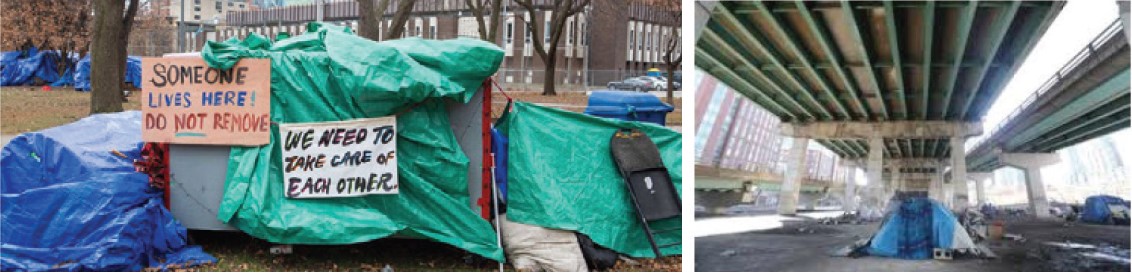
I am deeply passionate about in participating in urban design and architectural competitions since my student days, and I always participate whenever I have a chance. This time, I invited my dear friend and colleague, Robbie Suehiro, to join me in an at-tempt to respond to this important challenge. With this gesture, we hoped to contribute to finding solutions for one of the press-ing issues our city is facing. As always, we approached the task with great thoughtfulness and open hearts.
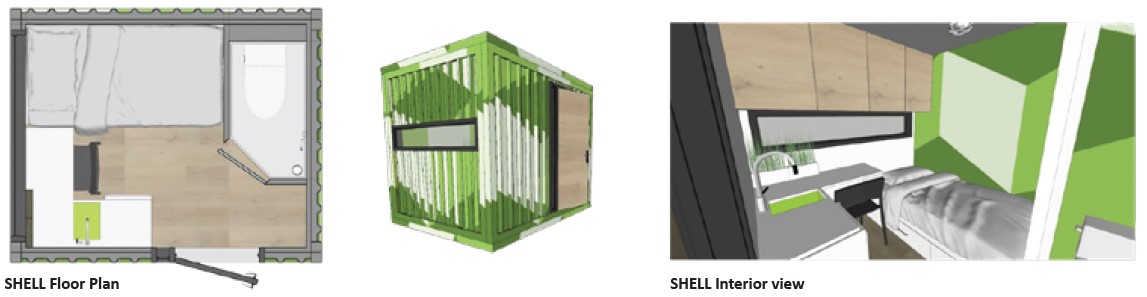
Our proposal is centered around a modular unit named the SHELL, a home designed to protect and support Toronto’s unsheltered residents. More than just a shelter, it offers dignity, privacy, and security. Unlike a tent or a shared dormitory-style bed, the SHELL provides personal space for those who value both freedom and independence. Each SHELL unit measures 3L x 2.4W x 2.6H meters and is housed within a modified shipping container, popular for temporary home solutions. Fully enclosed and insu-lated, it offers protection against extreme weather and hazards. The unit includes a secured entrance door, windows for provision of natural light, a double-size bed, a compact bathroom with a toilet and shower, a kitchenette, and a counter featuring a sink and mini-fridge that extends into a multi-functional work surface. A durable plastic chair, cupboards, a coat rack, power outlets fea-turing a sink, bar fridge, all in support daily living. It also features lighting, a smoke alarm, Wi-Fi, and an emergency alarm for added safety. Designed for versatility, the units are stackable and can be adapted to be fully accessible, ensuring inclusivity for all resi-dents.
In the second half of September, we submitted our pro-posal anonymously—a standard practice in open design compe-titions to ensure evaluations are based solely on design merit, eliminating potential biases related to participants’ identities. Our identities were known only to the West End Phoenix, not to Maytree nor the competition jury. The jury comprised eight influential community members: Alex Bozikovic, architecture critic for The Globe and Mail and instructor at the University of Toronto’s John H. Daniels Faculty of Architecture, Landscape, and Design; Valesa Faria, Executive Director of Development Re-view at the City of Toronto; Karen Kubey, urbanist and assistant professor at the same faculty; Diana Chan McNally, community and crisis worker in Toronto’s downtown east side; and Steve Teekens, Executive Director of Na-Me-Res, an organization sup-porting Indigenous men experiencing homelessness. At the end of November, Robbie and I were informed that we had been se-lected as one of four finalists. The West End Phoenix featured the finalist proposals in their December issue, and we were in-vited to a public presentation in January.
Each of the four finalist proposals, including ours, em-bodies the essential qualities of practicality, affordability, and dig-nity, ensuring realistic implementation and accessibility. With our SHELL proposal, we ensured that the requirements of “adequate housing” as defined by the Design Brief were fully met: security of tenure, availability of services, materials, facilities, and infrastruc-ture, affordability, habitability, accessibility, location, and cultural adequacy.
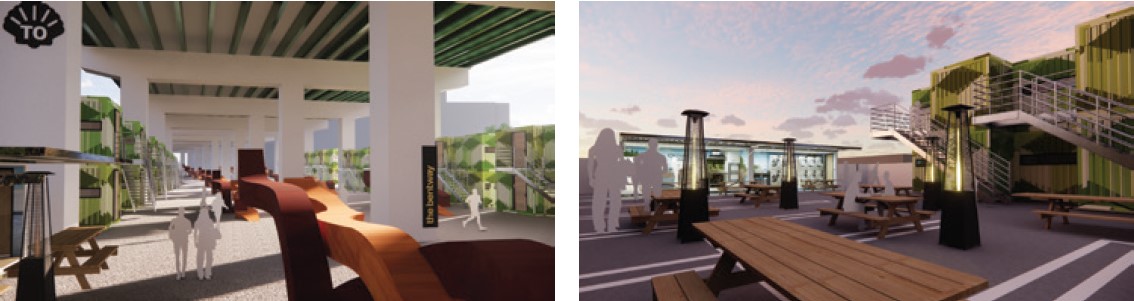
We propose arranging SHELL units into “Clusters” situat-ed in areas where individuals experiencing homelessness already feel secure and have chosen to reside. Potential locations include: peripheries of larger parks, especially in less frequented sections, beneath the Gardiner Expressway, complementing projects like The Bentway and elected municipal parking lots, utilizing adapta-ble, stacked and atrium configurations. While most clusters will be open to all community members, some could be designated for specific groups, such as Female Only, Indigenous Only, Loud Only, Quiet Only, Senior Only, Gay Only, Couples Only, or Pet Friendly.
To ensure safety and functionality, we propose assigning a minimum of two site attendants per 50 units, available 24/7. Their responsibilities would include reception duties, such as managing check-ins and check-outs; coordinating cleaning, food, and laundry services; and arranging maintenance and repairs. While meals and laundry could be provided as mobile services, we suggest adding a Community SHELL—a semi-open communal space for shared meals, laundry facilities, and social interaction—to foster a sense of community.
To ensure the feasibility of our proposal, we have con-ducted a thorough analysis of the costs associated with both the construction and operation of the SHELL units and their commu-nities. Each fully equipped SHELL unit, inclusive of a bathroom, is estimated to cost approximately $80,000 CAD. Consequently, the total budget for constructing 1,000 units is projected to be around $100 million CAD. We propose financing this initiative through contributions from various levels of government. The annual op-erational and security costs for these 1,000 units are estimated at $28 million CAD. To help offset these expenses, we suggest allocat-ing a portion of the units as short-term hostel accommodations or low-income rentals. Additionally, securing sponsorships could support meal programs and other essential services.
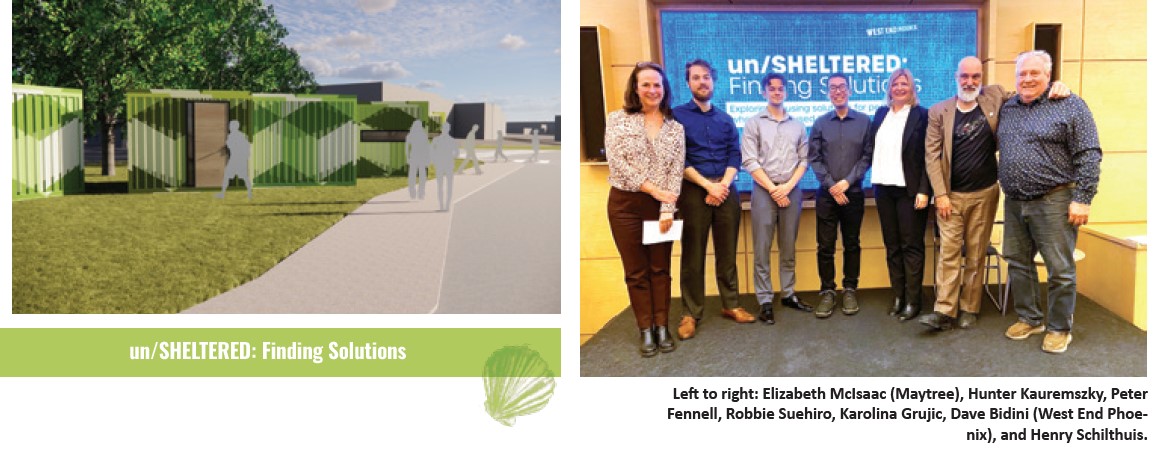
The public presentation, “un/SHELTERED: Finding Solu-tions,” was held on January 20, 2025, at Beeton Hall in the To-ronto Reference Library. Despite the extremely cold Canadian night, the event attracted 150 spectators and began with warm and humanitarian introductory remarks by Elizabeth McIsaac, president of the Maytree Foundation. The event was hosted by West End Phoenix. It featured a panel discussion on the urgency of the housing crisis and innovative solutions for unhoused indi-viduals in Toronto. Moderated by CBC’s David Common, the panel included three members of the competition jury: Alex Bozikovic, Diana Chan McNally, and Steve Teekens. After the panel, the four finalists of the competition briefly presented their entries. At the conclusion of the formal program, the host announced that Rob-bie and I were the winners of the competition for ideas.
Many of you may be wondering what happens next. Since this initiative isn’t backed by a specific investor with allo-cated funds for a particular project, it’s possible that, regrettably, no immediate action will follow beyond raising public awareness. The purpose of the Maytree initiative was to illuminate a path forward for those in positions of power, and we are proud to have contributed to this effort. This serves as a message to all who hold influence: use it for the greater good, not merely for personal gain or promotion.
Upcoming Events
Article Categories
- DIARY OF THE IMMIGRANT
- HIGHLIGHTS
- Editor's Note
- Trending
- Interview
- INTERVIEW: COFFEE WITH
- Canada
- Serbian Community
- Serbs Around the World
- Homeland
- Visit Serbia
- Life Today
- History and Traditions
- Through the Prism
- Business & Career & Finances
- New Destinations
- Arts & Culture
- Nurturing Serbian Language
- ABCs of Health
- Our Kitchen
- Diary of a Serbophile
- Sports and Hobbies
- Young Journalists
- Kids’ Page
- Our Youth
Fundraising Campaign for SAN
With your donation, you will contribute to the continued existence of the magazine as well as the maintenance of the website. Your name or company name will be included on our page “Our Sponsors”. If you wish you may also choose to remain anonymous (be sure to select the option to donate anonymously in the application). Thank you for considering to support SAN.
Donate Now