
MISSION OF THE LIBRARY OF THE “HOLY TRINITY” CHURCH-SCHOOL COMMUNITY IN MONTREAL
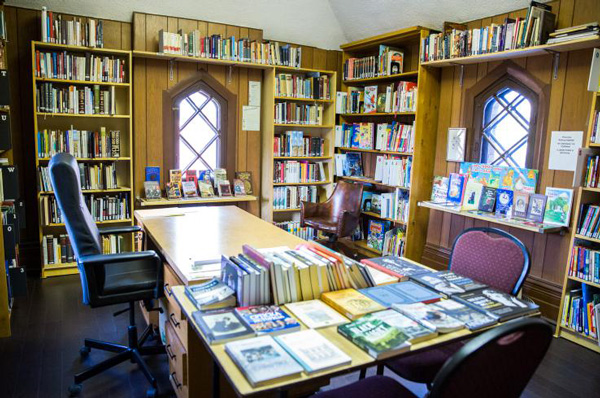
Members of the “Holy Trinity” Church-School Community from Montreal[1] deeply believe and show by example that, along with faith, language is the most reliable guardian of the culture, history and identity of a nation. Thus, in our Serbian community back in 1963, a library was founded through a donation from Stevan Jorgović’s parents. Ever since then, this library has been a bastion of defense and preservation of the Serbian language both spoken and written in this part of Canada. It is evident that those who worked in the library are the type that had an exceptional love for the written word and who showed persistent efforts and care for the preservation of the Serbian language and text.
Many people have filled in as librarians, but it is worth both admiration and respect that Mrs. Melanija Purić remained in that position for a full 28 years. Although she was not a professional librarian, she managed the existing collection of books very competently and created a solid foundation for the library that has been evident in these past five years. It is necessary to point out that the main type of procurement was by donation. Since post-war immigration predominated in Montreal, books in the library painted a picture of that society. While most of the books were in Serbian, a smaller number were in French and English, but many of the books were about the National Liberation War (NOB) and depicted the personalities of the time. Readers were informed about what the library was working on through the “Parish Gazette” of the church. A notebook, files and typewriter were used to list both books and library patrons.
In January 2017, at the invitation of Milina Zdjelarić, president of the Circle of Serbian Sisters “Mala Gospojina”, my work in the “Stevan Jorgović” library began with the reorganization of the existing library collection, as well as on the renewal of the book fund. As a Library and Information Science graduate with a degree from the Faculty of Philology at the University of Belgrade, I was already employed at the library of the McGill University Faculty of Law. Also, I was in my final year of the Master of Information Studies program at the same university.
The existing collection of books was quite outdated. Many books were damaged or unsuitable for learning the language. The first task was to discard such books, and to enrich the collection, albeit without a budget. Modest funds were allocated for the operational work of the library, but not for the renewal of the book collection. A commission was formed, which helped me evaluate and select which books to keep and which ones to write-off. In order for the library to successfully work on the promotion and preservation of the Serbian language, I made the decision going forward to accept donations and purchase books mostly in the Serbian language. As for books in foreign languages, the library will accept such donations only if the authors of the books are Serbs, or if the books are about Serbia or Serbs. This clearly defines the mission of the library as it works together with the Serbian Orthodox Church of the Holy Trinity in Montreal on the preservation of the Serbian language and culture, as well as the preservation of the Serbian national identity. The library had an extraordinary collection of world classics in the Serbian language, which also found its place in the reorganized library.
I am also in charge of organizing two teams of volunteers. The first team for cataloguing books (Bojana Pucar, Marco De Petrillo, Michel Erkić) and the second team for patron services (Tara Jotanović, Emily Zahirović, Michel Erkić, Mia Šekara). Among the volunteers were always students of postgraduate studies in information sciences, many of whom had no knowledge of the Serbian language or Cyrillic. One of them, a Canadian of Italian origin, learned to read Cyrillic after a while. Also, within the patron services group are young people from the community, which is a sufficient indicator that the library has become a place where they want to their spend time and make their contribution to the work we are doing. The list of volunteers is long and it is important to point out that each of them has made a huge contribution to the library’s work.
By the end of January 2017, all books were recorded in one volume. The Circle of Serbian Sisters “Mala Gospojina” bought a laptop for the library and we started testing out three free library information programs (Evergreen, Koha, OpenBiblio). The OpenBiblio program was selected and the electronic processing of the book collection was started. Following the example of the National Library of Serbia, the library uses the Universal Decimal Classification and an internal system for sorting library materials. An important step was to establish cooperation with the National Library of Serbia. Every book found in the library was cross-referenced with the catalogue of the National Library of Serbia, and books that the National Library of Serbia did not have were separated out. For the "Serbike" fund, the National Library of Serbia received 63 books published outside Serbia that were by Serbian authors. In return, representatives of the National Library of Serbia offered to help the library in Montreal rebuild its book collection. The great cooperation with the National Library of Serbia continued and remains to this day.
The Office for Cooperation with the Diaspora and Serbs in the Region through the Ministry of Foreign Affairs of the Republic of Serbia recognized our efforts to renew the library's collection. Their co-financing of the project “Development of reading in the Serbian language by enriching the book collections of libraries of Serbian organizations in the diaspora” is aimed at enabling and encouraging more significant use of the Serbian language and text to preserve national cultural identity and strengthen ties between the motherland and Serbs in the diaspora. The “Stevan Jorgović” Library received a significant number of books through this initiative.
At the time when the restoration of the library collection began in 2017, the collection of children’s books numbered about fifty books. Today, the “Stevan Jorgović” Library has almost 1,000 books for children and more than 2,000 books for adults. The library does not charge a membership fee, but insists on respecting the rules of using books and materials. By offering users access to books in their mother tongue, we encourage them not only to learn and remember Cyrillic and the Serbian language, but also to motivate them to learn more about Serbia, Serbian history and the greats of Serbian origin.
In order to promote itself, the library got its own Facebook Page[2]. Then, with the help of a developer, I worked on creating a library website[3]. The electronic catalogue[4] has also been integrated into the new site, enabling electronic search of the library’s holdings. All users are registered in an electronic database, so we know where the books are at all times. We believe that our library is one of the few in the diaspora that can boast of an electronic catalogue, professional development of the book collection and work on a professional level, even though it is run by volunteers.
At the 2018 Concordia University Research Forum in Montreal, I presented the research poster entitled, “The importance of mother tongue and the rebirth of a community library”[5] with my colleague Marco De Petrillo. The poster explains and presents how an almost forgotten and outdated small library with a modest book collection was rebirthed into a new, modern library, with no budget and no staff, but with help from passionate volunteers. In Quebec, as in the rest of Canada, there are many immigrants and many small ethnic communities who can find inspiration for preserving their language and culture in this presentation.
In 2018, the Office for Cooperation with the Diaspora and Serbs in the Region through the Ministry of Foreign Affairs of the Republic of Serbia supported the renewal project of the “Stevan Jorgović” library collection with funds in the amount of 200,000 RSD through the open competition for partially financing projects for the diaspora[6]. The goal of this project was to refresh the existing library with a new collection of books, while at the same time, bringing them closer to the members of the Serbian community in the diaspora. The aim was also to encourage them to learn and remember their mother tongue, history and culture of Serbia. A small collection of literary assets by Serbian authors in English and French was created in order to promote Serbian literature and culture to colleagues and friends from Canada (translations of works by Andrić, Selimović, Kiš, Pavić, etc. were purchased).
In the journal of the Quebec Library Association (January - April 2018), I published an article about the National Library of Serbia, including its concise history[7]. In it I also explained to colleagues from Quebec about the National Library of Serbia’s significance and the functions it performs.
In March 2019, the third “Salon Knjiga” (“Book Salon”) literary event was held in Toronto, which brings together Serbian writers who live and work in North America. During the event, more than 30 authors presented their works. At the initiative of the founder of “Salon Knjiga”, Mrs. Violeta Dimitrijević, all authors agreed to donate their works to the library in Montreal after the book event[8]. Mrs. Dimitrijević visited our library in May of the same year and brought books as a gift.
The “Stevan Jorgović” library within the Serbian Orthodox Church of the Holy Trinity is becoming the backbone of cultural events and the promotion of Serbian culture in Montreal. Numerous literary meetings, artist exhibits and theatre performances are organized. In 2019, in cooperation with the “St. Sava” School, the program “Jezikovanje” was created[9]. It is an intensive, interactive program for learning the Serbian language and Cyrillic alphabet.
Serbian people in the diaspora often face the situation of losing close contact with Serbia over time due to their distance and way of life. As a result, the Serbian language, writings and traditions are put in the background. In our case, in an environment where the official languages are French and English, the Serbian language is often pushed to third place. In order to stop or at least mitigate such occurrences, the preservation of language, and thus of national identity, based on a solid and sound foundation, is of the utmost importance. Without the huge, continual help of institutions from the motherland – the National Library of Serbia and the Office for Cooperation with the Diaspora and Serbs in the Region through the Ministry of Foreign Affairs of the Republic of Serbia – plus the unreserved support of our community led by priest Djordje Cimeš, our efforts would not be successful. Only with united forces and with the great support of the entire community is it possible to successfully survive as guardians of the Cyrillic alphabet and of Saint Sava’s teachings. Our library is an example of what can be achieved when people unite and work together.
This article is part of the Local Journalism Initiative.
[1] https://www.svetatrojica.ca/
[2] https://www.facebook.com/people/Biblioteka-Stevan-Jorgovic-Montreal/100015470165921/
[4] https://www.bibliotekamontreal.ca/katalog
[5] https://library.concordia.ca/about/staff/forum/files/2018/2018_Bozic_Erkic_dePetrillo.pdf
[6] Under ordinal number 41 http://www.dijaspora.gov.rs/wp-content/uploads/2018/05/Dijaspora2018konacno.pdf
[7] Pgs. 17-18. https://www.abqla.qc.ca/wp-content/uploads/2018/09/abqla-april-2018-lores.pdf
[8] https://www.vidohvat.com/2019/09/srpska-biblioteka-stevan-jorgovic-u.html
[9] https://www.svetatrojica.ca/organizacije/skola-sveti-sava/1874-2/
Upcoming Events
Article Categories
- DIARY OF THE IMMIGRANT
- HIGHLIGHTS
- Editor's Note
- Trending
- Interview
- INTERVIEW: COFFEE WITH
- Canada
- Serbian Community
- Serbs Around the World
- Homeland
- Visit Serbia
- Life Today
- History and Traditions
- Through the Prism
- Business & Career & Finances
- New Destinations
- Arts & Culture
- Nurturing Serbian Language
- ABCs of Health
- Our Kitchen
- Diary of a Serbophile
- Sports and Hobbies
- Young Journalists
- Kids’ Page
- Our Youth
Fundraising Campaign for SAN
With your donation, you will contribute to the continued existence of the magazine as well as the maintenance of the website. Your name or company name will be included on our page “Our Sponsors”. If you wish you may also choose to remain anonymous (be sure to select the option to donate anonymously in the application). Thank you for considering to support SAN.
Donate Now