
Kotor: Walking Through the Past and the Present - The City of Indigo Rivers
Indigo rivers flow down the mountain ridges and steep cliffs of the most beautiful fjord in the Balkans and splash the walls of the ancient city of Kotor, giving it an enchanting mystical air. But those misty waters cannot pass through those thick walls, so they continue to three doors through which they silently slip into town, bringing a certain melancholy to its inhabitants and tourists.
The steep surrounding mountains and its indigo, airborne rivers and city have always enchanted visitors that would pass along magical tales about it. One such story was written by Byzantine emperor and historiographer, Constantine VII Porphyrogenitus (905-959 C.E.), saying that it was a city around which the mountains are so tall that the sun can be seen only in summer, never in winter.
Past eras flow sluggishly through the streets of Kotor where one can feel the interwovenness of the different cultures and peoples that left their mark on the city.
Above all can be felt the Illyrian spirit. Linguists say that the old names for the Southern and Northern Gates—the Gurdich and Shkudra Gates, respectively— are of Illyrian origin. There is also a third gate and main gate, the Sea Gate.
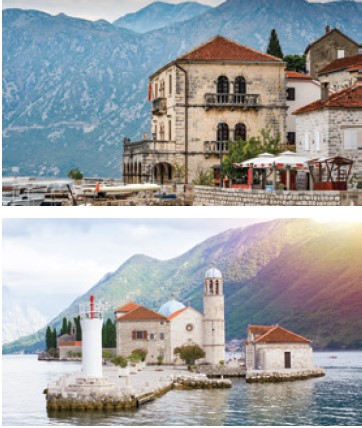
Somewhere in the labyrinth of stone streets is also the lost palace of King Michael I and Queen Jaquinta, of which only written traces of its existence are left.
A walk through the streets will reveal ancient stories, even one that tells that Kotor was once not a stone city at all: it was wooden, and its stone dwellings began to be built only in the 13th century. The first larger stone structure was the church of Saint Tryphon, today a symbol of the city. The first cathedral built in 809 C.E. was round and was also described by Porphyrogenitus, and its patrons were the Kotor nobleman Andreaci and his family. However, this original structure was demolished and a new cathedral was built in its place in 1166, in the new Romanesque style, the first of its kind on the eastern shores of the Adriatic. The large tripartite basilica with its two belltowers stood before its wonderstruck citizens as it does today before the tourists that photograph it.
At the time when Kotor belonged to the powerful medieval Serbian state—a period slightly short of two hundred years—four other large churches were built: St. Francis, St. Luke, St. Anne, and St. Maria Collegiate, all Catholic. On the church of St. Luke in Kotor, which was erected by Vukan Nemanjić in 1196, is engraved even today what titles he presented myself with: Rex Diolice, Dalmacie, Tribunie atque Tolizze. The church had two altars—one Catholic and one Orthodox—to over time become only Orthodox. There was one other Orthodox church built in 1808, but it burnt down, leading to the building of the new church of St. Nicholas in 1909.
One other palace disappeared among the narrow stone streets of the ancient city: the palace of the Nemanjićs. Stefan Nemanja built it after 1185, when he took over Zeta from the Greeks as his inheritance and birthplace. Up until the fall of the Serbian empire and the Battle of Kosovo, Kotor was a privileged city that was protected, built up, and granted concessions by the Nemanjićs. From that era (13th century) is the Pima Palace, one of the most beautiful buildings in Kotor.
Today, the spirit of the Nemanjićs is no longer felt in Kotor—time has irretrievably taken it away, and even tour guides rarely mention it.
What can be sensed is the luxurious Venetian spirit from the many buildings built during the time of Venetian dominion, from the 15th to the 18th centuries. The Clock Tower and the Pillar of Shame, the Rector’s Palace, the Flour Square, the Salad Square, Arms Square, the Buća Palace whose distant ancestor was a negotiator for King Milutin in the court of Charles of Valois, the Grgurina Palace housing today’s Maritime Museum—all beautiful baroque and Renaissance buildings that shine and compete with each other in their beauty; even the old prison attracts glances.
The upper ramparts of Kotor reach high up into the mountains until the Fortress of San Giovanni, which can be reached by 1,426 steps. The reward for the climb is a poetic one—an unsurpassed view of the Bay of Kotor and a beauty described in verse.
Since last year, the ancient Montenegrin city once habited by Illyrians, Serbs, Venetians, Russians, French, and Austro-Hungarians can be seen from above—from an 11-minute-long cable car from Kotor to Lovćen. From the heights, history can be better observed.
From the heights, one can see that Kotor’s inhabitants were always just their own.
Dignified and persistent, they held on to their beliefs so strongly that even the Pope excommunicated them. This happened in the 14th century when out of fear of any one family or church official rising to power, they degreed with a statute that nobody from Kotor could become a bishop. When a priest in Rome—Sergije de Bolica—was named Bishop of Kotor by the Pope, as he tried to enter the city with his family, the citizens of Kotor took away his property and did not allow him to enter. This angered the Pope, who excommunicated the citizens.
Kotor is a freedom-loving city which, in its past, rid itself of its noble overlords it grew tired of; thus, the common folk got their way.
Completely unique, forever its own, a city as hard as the rock from which it sprung, mystical and melancholic in the embrace of the indigo river which forever colours and inspires it from the mountaintops.
Upcoming Events
Article Categories
- DIARY OF THE IMMIGRANT
- HIGHLIGHTS
- Editor's Note
- Trending
- Interview
- INTERVIEW: COFFEE WITH
- Canada
- Serbian Community
- Serbs Around the World
- Homeland
- Visit Serbia
- Life Today
- History and Traditions
- Through the Prism
- Business & Career & Finances
- New Destinations
- Arts & Culture
- Nurturing Serbian Language
- ABCs of Health
- Our Kitchen
- Diary of a Serbophile
- Sports and Hobbies
- Young Journalists
- Kids’ Page
- Our Youth
Fundraising Campaign for SAN
With your donation, you will contribute to the continued existence of the magazine as well as the maintenance of the website. Your name or company name will be included on our page “Our Sponsors”. If you wish you may also choose to remain anonymous (be sure to select the option to donate anonymously in the application). Thank you for considering to support SAN.
Donate Now