
Gems and Legends from the Serbian Danube: Medieval Fortress Golubac, Djerdap National Park, and Prehistoric Settlement Lepenski Vir
When you visit Serbia—whether you grew up there or you are just visiting as a tourist—set aside at least one day for a trip outside the capital city of Belgrade and visit three sites of immense cultural, historical, and natural importance that leave every visitor speechless. Bonus: they are all along the Danube—the second-longest river in Europe.
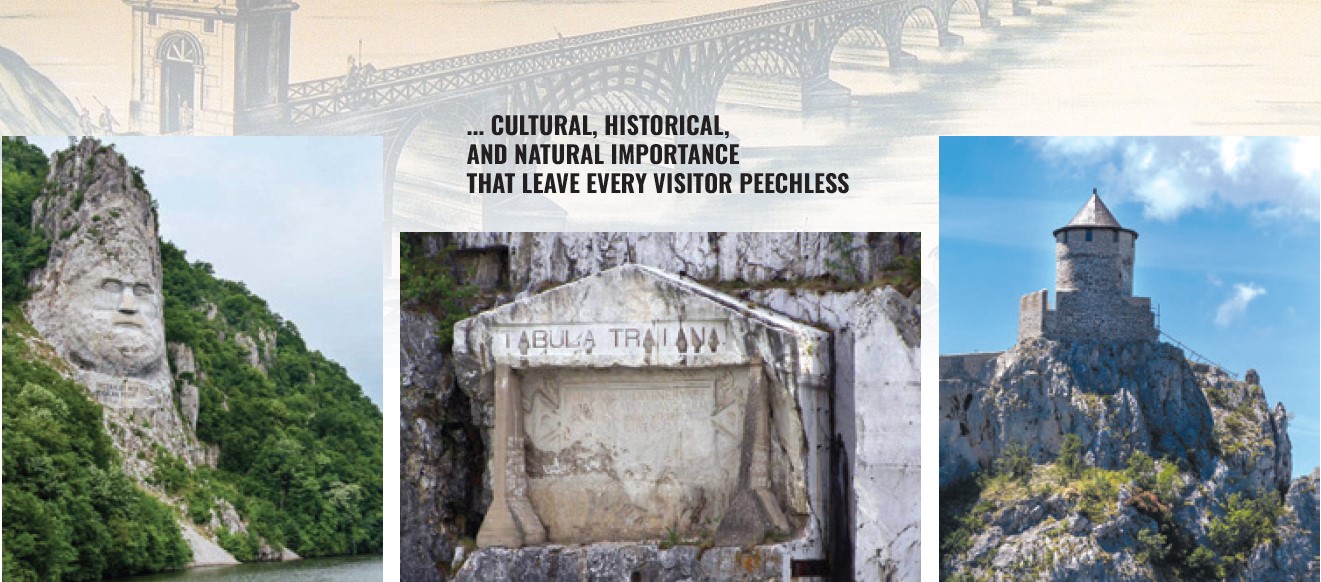
At the very entrance of Djerdap National Park (a UNESCO Global Geopark), we witness a very picturesque scene: at the place where the Danube suddenly narrows where it enters the Golubac gorge, against the steep cliffs of the shore, there shines the charming fortress of the medieval town of Golubac, with its impressive cascade of stone defensive towers connected by powerful ramparts. The most famous tower which draws the most attention due to its position is the dungeon tower, which due to its shape, is also called the “hat tower.”
Golubac fortress, one of the most beautiful and most important Danube fortresses of medieval Serbia, got a facelift in 2019. A fortification was first mentioned in 14th-century writings, built either by the Hungarians or the Serbs, then later rebuilt by Despot Stefan at the beginning of the 15th century. It later fell into the hands of the Ottoman Empire, and was returned to the Serbs only after the First Serbian Uprising in 1813.
The name of this beautiful fortress—which was even drawn on old maps—is the subject of several legends, all of which are connected to the word golub, meaning “pigeon” in many languages. The most popular legend tells that the fortress got its name from a beautiful girl named Golubina who, after refusing to enter the harem of the local Ottoman commander, was punished by being chained to a rock in the middle of the Danube, in order to make her repent. The rock named Babakaj, meaning “repent” in Turkish, inspired Djordje Krstić to immortalize it in his painting, and Vojislav Ilić to write a poem on the theme. Another legend says that the dungeon tower held the Byzantine princess Helena, who out of sadness and loneliness, raised pigeons, and thus gave the name Golubac to the town.
Along the right bank of the Danube, from the town of Golubac to the Diana Fortress (or Diana Karataš, a Roman and early Byzantine camp), a distance of around 100 kilometers, runs the forest-covered and hilly Djerdap National Park. Breathtaking nature and millennia of history await curious nature lovers. Nine hiking trails of varying lengths and inclines pass through forests, nature reserves, and a unique wild botanical garden, right up to heavenly panoramic views where the Danube looks like it is winding in the palm of your hand.
The park is famous for its grandiose Djerdap gorge, the largest of its kind in Europe, in which four smaller gorges and three basins run into each other over the course of 100 kilometers. The most beautiful of the string of gorges is the Veliki kazan, or “large cauldron,” whose name is truly the best description of the relief at that part of the Danube: around 170 meters of river width squeezed between steep cliffs several hundred meters high.
The hiking trail Mali Štrbac leads to the eponymous vista located at 626 meters above sea level, right above the Veliki Kazan, from where you can see an impressive view on the most beautiful part of the Djerdap gorge; the Romanian shore; a forested hinterland with a stone statue of Decebalus, the last king of the Dacians; and the monastery Mrakonija at the entrance to the eponymous bay.
It is also impressive to visit the Djerdap gorge by boat, taking the river route. While navigating down the Gospodjin vir basin, yet another one of Djerdap’s phenomena is experienced: that being the Danube depth of 82 meters, considered one of the greatest river depths in the world. A boat ride is also the only way to see Trajan’s Plaque (Tabula Traiana), a historical monument from the beginning of the 2nd century CE carved into the rocks above the Danube during the time of the Roman emperor Trajan, installed at the least accessible part of the Roman road. This was the route the Roman emperor and his soldiers took to wage war against the Dacians, and here the Danube was bridged 1,100 meters by Trajan’s Bridge, which was the longest bridge in history for around a thousand years. The plaque contains a Latin inscription in six rows which states—after the emperor’s name and all his titles—that he defeated the Danubian and mountain rocks and built a bridge. The bridge was built of stone, had a series of arches above the water, and was made up of twenty pillars. It was Trajan’s idea to connect Upper Moesia and Dacia, and the bridge was contrived by Apollodorus of Damascus, the greatest architect of the time. The bridge was destroyed on the orders of Emperor Aurelian (270-275) when the Romans had to leave Dacia due to the onslaught of barbarian tribes. Other sources say that it was destroyed 20 years after it was built, on the orders of Hadrian (117-138) which is less likely, seeing as the Romans still ruled Dacia at that time. Still others believe that it collapsed much later due to the force of the water. Twenty pillars were still visible in 1856, when the water level of the Danube was still low. In 1906, the European Danube Commission decided to destroy two of them, as they interfered with the navigation of boats. The remains of 16 pillars of Trajan’s Bridge could still be found in the mid-20th century (1932) but half a century later, archeologists have been able to locate only 12 of them. Four of them have likely been carried away by the current. The remains of the first columns on both sides of the river can still be seen today on the shores of the Danube.
Throughout history, the Bulgarians, Romanians, Slovaks, and Germans called our gorge the “Iron Gates;” the Turks, the equivalent “Demir kapi”. In Serbia, the name remained “Djerdap,” likely stemming from the Turkish word girdap, meaning whirlpool or dangerous place. Djerdap was visited by the Turkish travel writer Evliya Çelebi in the 17th century during Ottoman rule, and his visit was recorded in his ten-volume travelogue masterpiece Seyahatnâme (Book of Travel). After mentioning several “demir kapi” straits and gorges, he says, “Of all the mentioned demir kapi, the one that causes the most torment is this Danubian demir kapi, in which every year hundreds of boats are destroyed and thousands of people drown!”
After a walk around the national park, you cannot miss the opportunity to visit the prehistoric settlement of Lepenski Vir, located within the geopark next to the river Danube by the village Boljetin, not far from Donji Milanovac.
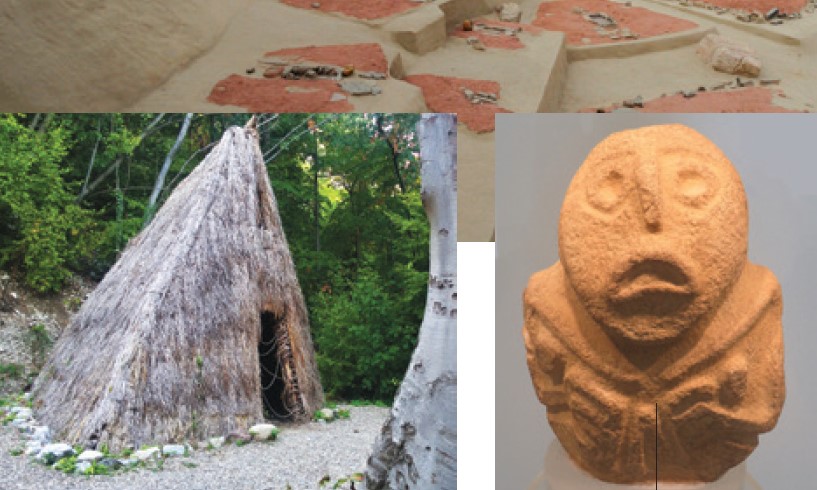
An attractive steel and glass construction protects Lepenski Vir, the oldest “urban” settlement in Europe. The remains of trapezoidal foundations with their entryways facing east, cascadingly strung together towards the Danube, indicates a prehistoric people of this land that was familiar with agriculture and animal husbandry, and thoughtfully planned their settlements in the period between 6,300 and 5,500 BCE, during the Mesolithic and early Neolithic eras.
The archeological findings in Lepenski Vir not only revealed the remains of settlements and house-building concepts, but also necropolises and unique, monumental stone sculptures, as well as numerous objects made of bone and stone which bear witness to the existence of not only a housing development, but also a sacral hub.
The most famous discoveries at Lepenski Vir, besides the settlement itself, are the prehistoric sculptures and altars made of large stones, which were discovered covered in limestone mortar in the floors of houses, most often located at the hearth. Two thematically different types of sculptures were discovered: figural sculptures in human form, and ornamental sculptures decorated with meanders, fish bones, or braids.
The most famous sculpture from Lepenski Vir known and recognized around the world is the so-called Praroditeljka, or “foremother,” from the period between 6,300 and 5,900 BCE. The fish-like artistic depiction of the human face is connected to the community’s focus on the river. It was discovered in 1971 by archeologist Dr. Dragoslav Srejović. The original is housed in the National Museum in Belgrade, and a copy can be seen at the site.
Golubac Fortress, Djerdap National Park, and Lepenski Vir represent the union of nature and cultural heritage, since the specific natural features of this region led to the creation of this incredibly valuable cultural heritage.
Upcoming Events
Article Categories
- DIARY OF THE IMMIGRANT
- HIGHLIGHTS
- Editor's Note
- Trending
- Interview
- INTERVIEW: COFFEE WITH
- Canada
- Serbian Community
- Serbs Around the World
- Homeland
- Visit Serbia
- Life Today
- History and Traditions
- Through the Prism
- Business & Career & Finances
- New Destinations
- Arts & Culture
- Nurturing Serbian Language
- ABCs of Health
- Our Kitchen
- Diary of a Serbophile
- Sports and Hobbies
- Young Journalists
- Kids’ Page
- Our Youth
Fundraising Campaign for SAN
With your donation, you will contribute to the continued existence of the magazine as well as the maintenance of the website. Your name or company name will be included on our page “Our Sponsors”. If you wish you may also choose to remain anonymous (be sure to select the option to donate anonymously in the application). Thank you for considering to support SAN.
Donate Now