
Let’s have clear communication and writing!
How many times have you found yourself at a meeting, conference, training session, or even at a private gathering, listening to someone and not understanding a word? A person is speaking fast and without breaks, he/she is using some “high level language” and a lot of acronyms, and it is very difficult to follow the conversation, and or presentattion. In the moment you find yourself admiring a presenter and how smart he/she may appear, and you feel bad about yourself and your level of English. This is a common trap! Presentors such as these are not very good, as they are not adjusting their presentation to the level of a specific audience.They are trying so hard to appear “superior and are not achieving the objective of delivering the speech/presentation in a clear and understandable way.
Not only is clear communication important in delivering speeches, presenting at meetings, trainings etc. but clear communication is also extremely important in writing. In writing there are certain rules to help achieve the most clear and efficient communication. To simplify, we will give the example of writing emails. The first piece of advice is to use the “top down” structuring approach in writing the (izbaci the)emails. The most important points should be in the very beginning. The middle part follows with the explanation. Finally, at the very end comes the conclusion. The only exception to this writing approach is when delivering bad news.
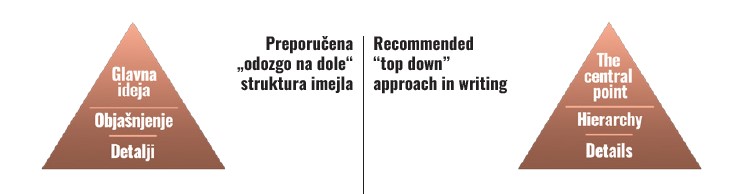
It is recommended to have no more than 14 words per sentence, 75 words per paragraph and no more than three ideas in an email.
The Canadian Press Stylebook advises: “Read a story three times: once for content, once to edit and once to clean it up.” Nowadays we have available powerful grammar check, language, and spelling tools, but software will not solve all our problems. A writer still must format the text in the manner that sentences are not too long, and they are placed in the paragraphs to provide better and logical grouping of the ideas.
Some final points about langage use. Use active instead of passive voice, as with the passive voice it becomes unclear who is a (the umjesto a) subject of the matter, who is responsible, what are the actions and next steps, etc. Be specific and avoid ambiguous words, such as shall or should, instead use “must” for the obligation, “will” for future tense, “is” for a fact, and “may” for permission. Avoid ambiguity and double negatives. Avoid using Latin abbreviations such as e.g. (meaning ‘for example”) and i.e. (that is). Do not use redundant and ineffective words, sentences, phrases and oxymorons.
Examples of redundancies (unnecessary repetitions): new innovations, end result, etc.
Examples of oxymorons (apparently contradictory words): exact estimate, new classic, etc.
Avoid using jargon and acronyms as a special form of jargon. It is recommendable to put the acronym in brackets. A void using technical language without explanation. The rule for numbers is the following: spell out the numbers below 10 and use figures for 10 and above.
Some recommendations on proper use of words:
About/on – Avoid using on as a way of saying about.
Impact – Avoid using impact as if it were a verb synonymous with affect. Impact is a noun.
Its/It’s – Its is the possessive of it; it’s is the contraction of it is.
May/might/can – The phrase may have indicates the possibility that it still exists, while might have expressed the possibility that it no longer exists or it is unlikely to exist .
One/those – It is preferable to use concrete nouns such as clients, coordinators, patients, rather than a pronoun which may dehumanize the subject.
That/which – Use that when the words following it are critical to the meaning of the sentence. Use which, followed by a comma, when the words following it are not essential to the meaning of the sentence. For example: The new bilingual issue of SAN that we created in winter is excellent. The earlier version, which was drafted in late fall was revised.
Who/whom- Use who when it is a subject of a verb and whom when it is the object of a verb preposition. Example: The journalist who wrote the article; the journalist whom I met last month. Note that word whom is very formal and is falling into disuse, especially in questions. In the above example it is better to say: the journalist who I met last month.
Upcoming Events
Article Categories
- DIARY OF THE IMMIGRANT
- HIGHLIGHTS
- Editor's Note
- Trending
- Interview
- INTERVIEW: COFFEE WITH
- Canada
- Serbian Community
- Serbs Around the World
- Homeland
- Visit Serbia
- Life Today
- History and Traditions
- Through the Prism
- Business & Career & Finances
- New Destinations
- Arts & Culture
- Nurturing Serbian Language
- ABCs of Health
- Our Kitchen
- Diary of a Serbophile
- Sports and Hobbies
- Young Journalists
- Kids’ Page
- Our Youth
Fundraising Campaign for SAN
With your donation, you will contribute to the continued existence of the magazine as well as the maintenance of the website. Your name or company name will be included on our page “Our Sponsors”. If you wish you may also choose to remain anonymous (be sure to select the option to donate anonymously in the application). Thank you for considering to support SAN.
Donate Now