
The Country of the Berbers in the Atlas Foothills
|
|
This was my first trip to Africa, and that in its northernmost and closest country to Europe, Morocco. The adventure started with the touchdown in Casablanca. There, we were met by a driver, and just sped along large, sandy and palm-lined boulevards, leaving the city sightseeing for another day. Our guide and the rest of our group was waiting for us in Marrakesh. A few hours later, Marrakesh, the “Red City,” dazzled me with the colour of its facades and its architectural authenticity. A bit of sand, a bit of dust, some crowds, some strange traffic, many people, vehicles; and all the facades the same colour of red sand. The buildings look as though made of playdough by children. Here and there, the sandy facades are broken up by tile mosaics, filigree borders around the windows, and carvings on wooden doors. Morocco is a good starting point for all those who have fallen asleep in the pastel colours of life, to once again question themselves about giving up on their dreams or the intensity of their life’s happiness. Strong colours bring bravery into your life, open your eyes wide, and heighten the sensitivity of all the senses. The colours are inside the people, their lives and dreams, with which Moroccans—particularly women—enrich this part of Africa. The interiors of hotels, riads, museums, restaurants, and bakeries are opened up by the sumptuous colourful decor, the trademark of Morocco; rugs, copper lamps, mosaic tile floors and walls, all in the most colourful designs. The city of Marrakesh, or “Little Paris” as dubbed by Churchill, is full on contrasts. Humble houses next to luxurious hotels; cobblestones and boulevards; pedestrians and cars; horse-drawn carriages for panoramic tours and tall tinted jeeps; all in the same place. In the open square of the souk and medina, you can smell spices, and coffee brewing in the sand; mint tea is poured out of silver teapots; heavy grindstones press argan and grind almonds. You can find snakes and monkeys for photo ops, various delicacies, hand-woven textiles and rugs, laden camels! The square Jemaa el-Fnaa is the lifeline of the Moroccan city of Marrakesh. In the daytime, the square is full of snake charmers, henna tattoo artists, and various other entertainers, while at night you can find countless stalls where you can buy traditional lamb dishes, freshly squeezed orange juice, and many other specialties. Tourists come here throughout the whole year to experience the real atmosphere of Marrakesh and discover all the amusing things the local population has to offer. In the middle of that commotion and noise, a few minutes from our hotel, is the Jardin Majorelle, the oasis of the eponymous French painter. The garden surrounds the house which was built in the Cubist style and which was his atelier, but it is the garden that made him more famous than his paintings. He brought many plants from his travels and replanted them in this garden. As fate would have it, the property later came into the hands of Yves Saint Laurent while he was in Marrakesh looking for inspirations for his models and oriental designs. The designer added lemon-yellow and orange planters full of gigantic cacti to the navy-blue facade.
|
|
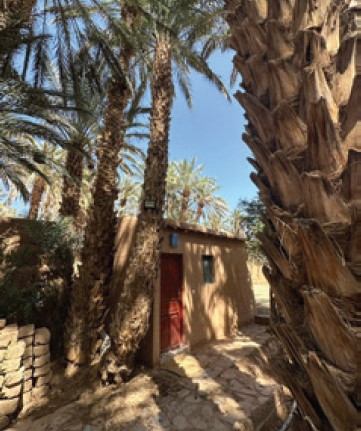
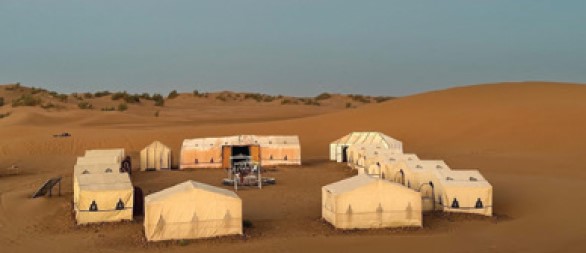
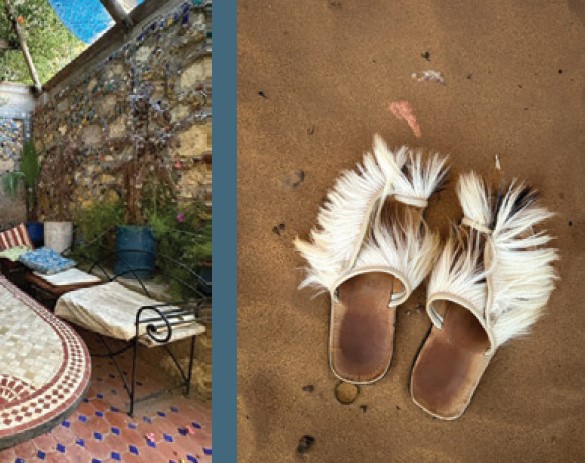
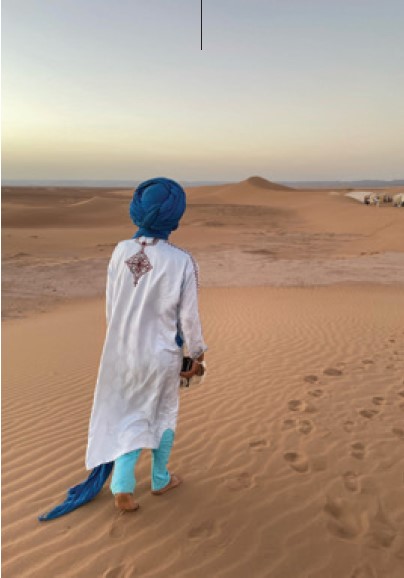
Our walk leads us to several pavilions, one of which is the Berber Art Museum. Photography is not allowed, but beside incredible articles of clothing, jewellery, swords, dishes and other items, the place of honour is reserved by a room full of mirrors and the starry sky. A museum dedicated to the creations and fashion evolution of Yves Saint Laurent, as well as a small jewellery boutique, are in the last pavilion. Between these two museums is a restaurant in the garden: an oasis in the city that has not seen rain for three years. When you think about global warming, you feel guilty for not traveling more on foot. So, let’s take a walk around Marrakesh. We meet our guide at the hotel. He introduced himself, said he was from a village in the Atlas Mountains, that he is Berber, and that he knows the desert well. The indigenous inhabitants of northern Africa, those who were there before the ancient Romans and even the Arabs, are the Berbers. A large number of them are in Morocco, but also in the other northern countries of the continent. Their primary religion is Islam, which they received from the Arabs, and in Morocco they live more south towards the Sahara. The Berbers have a characteristic lifestyle and unique settlements in the hills, and used to work in camel transport caravans across the desert. Today, they work mostly in tourism. From Marrakesh, we headed south towards the Sahara, on a very good but winding road – Tizi N’Tichka—which cuts across the Atlas Mountain range and passes through Berber villages that are literally built into the mountain like little mouse holes, and constructed of red-orange bricks and sand. There is almost no plant life, but that rugged landscape has its charm. After a long drive, we reach Atlas Studios at the end of a steep road. Unfortunately, some places were closed due to an earthquake, so we were not able to visit Aït Ben Haddou, a UNESCO-protected city used to film Lawrence of Arabia and many others. A visit to the studio was like traveling through time: the light is wonderfully adjusted for taking pictures, and for fun, our guide took a few videos of us playing the main characters, so we could really feel the magic of this Moroccan “Hollywood” set. The movies Gladiator, Prince of Persia, and Game of Thrones were all filmed here, and we heard several anecdotes about them. We continued our journey through gorges and canyons, as if the mountain were cut by a road. First up into the mountain, then down into the desert. At dusk, we arrived to a hotel in the traditional style: a foyer with divans, colourful kilims, wooden doors with locks and carvings. Dinner was sumptuous: stews, lamb and chicken in earthenware pots, and many fruits and vegetables. In the morning after breakfast, we continued towards the desert. A break for lunch in the garden of a restaurant, and the purchase of colourful scarves that we learned to tie; the biggest and juiciest dates we had ever had; and lots of water, as we could already feel the desert heat. Then, suddenly, we stopped in the middle of what seemed like nowhere, a flat horizon in front of us, ready for two hours on foot across the desert. A Berber man named Mohammed was our guide. He was dressed in a long white tunic decorated with characteristic blue embroidery, which had a large pocket on the breast. Below his tunic, he wore blue pants and camel-hair sandals; on his head, a blue turban. He walked easily and evenly, and as soon as I caught sight of the sand dunes in front of us, our walking turned into sailing. As our line stretched out and our footsteps spread out, every one of us made our own path. I was constantly taking pictures, going up and down the dunes, sometimes sinking into the sand up to my knees. I just let the sand and the orange, golden, and grey tones take over. After a long walk, we found ourselves under a tree, under which large rugs, colourful mats, and comfortable pillow had already been set up, so we took a load off. The temperature was around 40° Celsius, but a very pleasant wind was blowing and the air was dry; I only felt very thirsty, but not hot. We were served tea, various nuts, and dates, and a tagine was being prepared in earthenware. We continued our journey until sunset. When the sun sets into the horizon of the sea, somehow everything has a silvery-coppery shine, but when the sun sets into the sand, the shadows paint a true Dadaist picture. Watching the sunset from the tallest dune was a surprise—blink, and it was gone. Going down the dunes is unbridled joy or rolling, depending on your persuasion. It must be experienced; it is hard to describe. Maybe it should just be photographed! On the other side of the tallest dune, we saw our camp, with large white tents and beds set up in a circle. Dinner, then a bonfire, Berber songs and our own improvisation, laughter and dancing around the fire, deep into the night. The moon happened to be full that night, shining like a reflector, and not even the sun at dawn could chase it away. Good night—or temsiwin in Berber! Morning. Before dawn, we jumped out of our beds and like starlings we flew up the high dunes surrounding the camp. Tea and coffee, breakfast, and then a camel safari. The camels were all sitting on the sand, and we were instructed to choose our steed for the day. I approached one called Sugar. I was quite uneasy as he was standing—first on his hind legs— and I found my head lower than his hind parts. With some good instructions, I sat up in the saddle—which is quite wide—and after some squirming, I found a comfortable position. The camels are otherwise always male; they say that the females can cause jealousy and nipping. A new experience, and a new look at the immense mountains of golden sand. After a few hours, a break and lunch in the middle of nowhere, followed by rally Jeep driving off the main road, if there even is such a thing. There were sharp turns, and jumps, and getting stuck in the sand, and turnovers to the squeals and screams of passengers. Before sunset, a new camp and a new experience. This time, they set up small tents, but the night was warm and comfortable for sleeping even on rugs and kilims. Gathered around the fire listening to the sounds of traditional music, we were happy to eat the bread that Mohammed had baked in the sand. Our return towards Marrakesh was through new canyons and winding roads, beautiful villages, and green palm oases but also well-maintained nursery gardens. We stopped near Ouarzazate, in a riad with a pool and showers, to cool off, rinse off the sand, and have lunch. A riad is a traditional house with rooms to rent which usually has its garden in the middle. This one was large, like an oasis nestled among the hills. Upon our return Marrakesh, the second part of our trip started. Sailing along the coast and visiting several fishing villages, full of surfers, boho restaurants, lazy yet vivid hedonism, and seafood. This enchanted us with a different kind of charm. We visited Faruha’s kitchen and learned how to make tagine. We took pictures of goats climbing argan trees and eating the fruit. We shopped for argan oil, honey, and almond butter. In the souks and medinas, we shopped for rugs, throws, pillowcases, black soaps, leather poufs, all made by hand in small productions. We sunbathed, sailed in small boats, climbed up and down hilly seaside roads. The blue and white of the sea soothed the scorching colours of central Morocco.
|
|
Upcoming Events
Article Categories
- DIARY OF THE IMMIGRANT
- HIGHLIGHTS
- Editor's Note
- Trending
- Interview
- INTERVIEW: COFFEE WITH
- Canada
- Serbian Community
- Serbs Around the World
- Homeland
- Visit Serbia
- Life Today
- History and Traditions
- Through the Prism
- Business & Career & Finances
- New Destinations
- Arts & Culture
- Nurturing Serbian Language
- ABCs of Health
- Our Kitchen
- Diary of a Serbophile
- Sports and Hobbies
- Young Journalists
- Kids’ Page
- Our Youth
Fundraising Campaign for SAN
With your donation, you will contribute to the continued existence of the magazine as well as the maintenance of the website. Your name or company name will be included on our page “Our Sponsors”. If you wish you may also choose to remain anonymous (be sure to select the option to donate anonymously in the application). Thank you for considering to support SAN.
Donate Now