
Zapis, the Sacred Tree
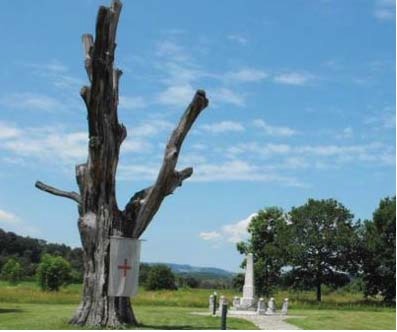
The ancient Slavs have always had a deep reverence for nature, especially towards trees. Once, there was even an old Serbian custom to kneel in front of a tree before it was cut down, asking it for forgiveness. However, this has almost completely disappeared from practicein modern times.
Long ago, in every Serbian village there was a certain tree – a shrine. That tree was called zapis (inscription), because a cross was inscribed or otherwise marked into its bark. Such a tree was sacred. According to Veselin Čajkanović, the Serbian religious historian, the origins of the zapis stretch as far back as the pagan, pre-Christian, period, when such a tree functioned as a temple. It was usually a larger tree that became selected as a zapis, often an oak, and it represented the sanctity of the entire village. Among the ancient Slavs, the oak tree was considered the tree of Perun, the thunder god. Besides an oak, the zapis can also be a European yew, European hornbeam, Austrian oak, or linden tree.
Zapis, the sacred tree, was the guardian of every settlement. In the time of Turkish rule, the zapis functioned in place of a church – the Christian liturgy was performed beneath its boughs. Prayers were recited, meetings and trials were held in its shade, and it was considered a “shield against lightning.” No one was permitted to climb it or sleep under its boughs. Its fruits were not plucked, nor its branches broken, and it was never to be cut down. To this very day, people in certain areas are not allowed to gather or even move branches which have fallen off on their own.
A village can have multiple zapis trees: the main zapis is always in the middle of the village and serves as the cult centre. Often there were additional zapis trees which surrounded the settlement on various sides. The zapis fulfilled its most important role during the celebrations that surrounded the village’s zavetina (village Slava), and it was then that the villagers gathered around the tree as if it were a church. The zavetina, or the celebration which is held in the name of the Saint of an entire village, was of great significance. Its name stems from a time when the village would swear an oath (zavet) to commemorate the Saint who would protect them from great misfortunes. The celebration would begin with a gathering around the zapis, where the priest would read prayers along with the villagers. First, the cross would always be re-engraved into the same place on the tree, after which everyone would walk around the tree three times, and finally, wet the tree with wine. The cross inscription was always placed on the West side of the zapis so that whoever stood in front of it was facing the East, just like at the altar of a church. Following the bestowal of offerings such as flowers and fruits, the litija (or service) of the Slava was started throughout the entire village. The same ritual was held at every other tree that was believed to be sacred. During the litija, prayers were recited with the intention of dispelling illness and misfortune from the village, such as droughts or any other natural disasters. After the litija, the villagers continued the celebration with a feast and other merriments.
Often, there were so-called “feast tables,” made out of large boulders or tree trunks, set next to the zapis tree, which served as a place where offerings would be left. Sometimes, the area around the tree would be enclosed by a wooden fence, which was called a porta in the Šumadija region. Aside from the offering table, simple edifices, known as sobrašice, were also erected in some parts of Eastern Serbia. These sobrašice, built next to the zapis, had no walls, just a small roof. A bench and table were placed under this roof, and this would have been the collective dining area during the village’s Slava. Following World War II, celebrating the village’s Slava by the zapis tree was banned in certain areas so that all of the ceremonies might be contained within the grounds of the local church.
Although the celebration of the village’s zavetina around the zapis tree is no longer practiced, there is still a strong belief throughout Serbia that anyone who desecrates the zapis would be punished. Ethnological studies of this meaningful custom have confirmed that many villagers still know which tree is designated as the zapis, and nearly all adhere to the injunction against harming it. The extent to which the respect for the sacred tree permeates a community is also demonstrated in studies done in Eastern Serbia, where the bark which falls off of the tree must be left untouched. In a village near Zaječar, there is even a recorded incident of a tree, which was identified as the zapis, that was not moved even though it had fallen across the road. In this case, the local villagers went so far as to excavate a new road so that the tree may be left untouched.
The sacred tree had a significant role which went beyond the religious sphere and into the social one as well. Since it was believed that no one was able to lie at a holy place, trials and confessions were held at the zapis. It was there that important matters pertaining to the community were also decided. Thus, the Second Serbian Uprising was initiated in 1815 under a certain zapis oak, known as “Takovski Grm.”
Similar relationships between a tree and community are found in Macedonia as well, although there, the trees were not known under the name zapis. In the Gevgelija region a pear tree is presented with oblations: first, it is surrounded with icons, after which the priest reads the gospels and sprinkles the tree with holy water, and finally, places the eucharist under the tree’s roots. In other regions, a cross, hearth, and rock table are placed next to a tree growing on a small hill next to running water.
The Custom of Cutting the Badnjak – Its Origin and Significance
Even today, the cult of the tree is retained in our national religion through Christmas (Božić), the greatest of religious observances, where the badnjak (oak branch) represents the deity, the spirit of nature, which is ritually burned so that it may be reborn. In this way, the cycle of renewal in nature is maintained.
The custom of the cutting the badnjak does, however, have a strong Christian significance – the branches of an Austrian or regular oak tree are burned in order to be reborn. According to tradition, because of this the badnjak is cut early in the morning and while wearing gloves. During the cutting of the branch, the tree is brought offerings of wheat or animal sacrifice. Usually the badnjak is cut by the head of the household, but only after they wish the badnjak tree a happy Christmas (Božić), and only accompanied by apologies and prayers for forgiveness.
When the badnjak branch is carried into the home, the members of the household present it with offerings: they scatter wheat over it, sometimes sprinkling it with wine, and in certain places there was once a custom of each individual kissing the branch. The Badnjak is ritually burned during Christmas (Božić), and the fire is poked as wishes are made for luck, good health, happiness, fertility, good crops, and prosperity.
Upcoming Events
Article Categories
- DIARY OF THE IMMIGRANT
- HIGHLIGHTS
- Editor's Note
- Trending
- Interview
- INTERVIEW: COFFEE WITH
- Canada
- Serbian Community
- Serbs Around the World
- Homeland
- Visit Serbia
- Life Today
- History and Traditions
- Through the Prism
- Business & Career & Finances
- New Destinations
- Arts & Culture
- Nurturing Serbian Language
- ABCs of Health
- Our Kitchen
- Diary of a Serbophile
- Sports and Hobbies
- Young Journalists
- Kids’ Page
- Our Youth
Fundraising Campaign for SAN
With your donation, you will contribute to the continued existence of the magazine as well as the maintenance of the website. Your name or company name will be included on our page “Our Sponsors”. If you wish you may also choose to remain anonymous (be sure to select the option to donate anonymously in the application). Thank you for considering to support SAN.
Donate Now