
How Many Rivers Does Belgrade Have?
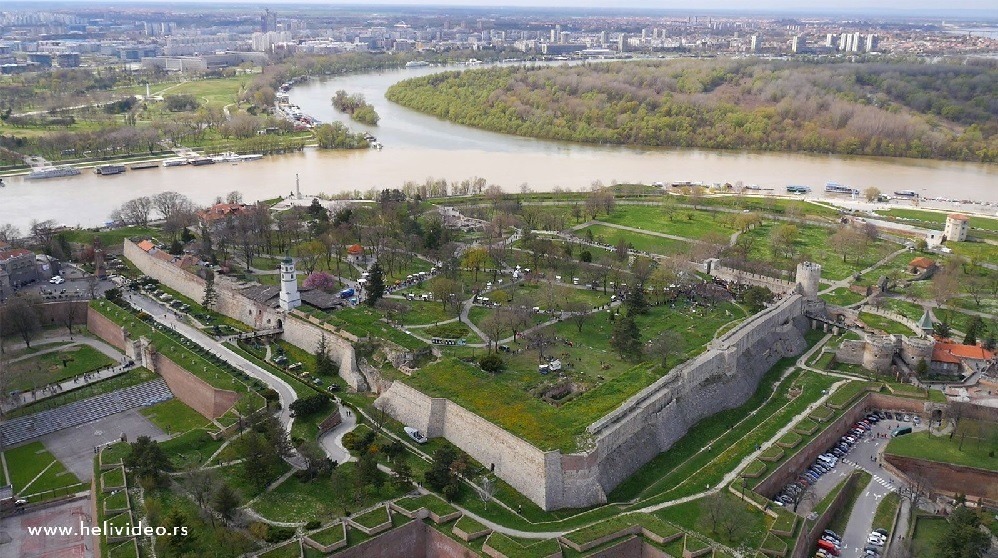
“Exploring unfamiliar, underground areas underneath Belgrade is like trying to understand its extraordinary history: it is reminiscent of putting one’s hand into a container with no bottom, since every time you take your hand out, another wonder is found, or at least something significant had been felt inside. And as long as there is some idea of where your hand is going, somewhere in that semi-darkness, the past looks real and immediate”
- Zoran Lj. Nikolić and Dr. Vidoje D. Golubović
In certain appropriate conversations, I often ask: “How many rivers does Belgrade have?” Usually I get a bewildered look, a look which wonders why I even ask such a question, followed by a reticent answer: “the Danube and Sava, everyone knows that.” After having seen my expression, there is usually an addition: “Sorry, I forgot about the Topčidarska River.” I would think the same too if I hadn’t come across this book, having been exploring Belgrade’s subterranean secrets since long ago, when I was just a student.
In my group of students, there was a certain S.G. – a naturalist, a young doctoral student, and future professor at the University of Novi Sad. The beauty and wonders of nature taught us much, as he led us through Košutnjak, Topčider, the “adas” (river islands), the “ritas” (marshlands), and even Kalemegdan. We gazed into the lagoons, vineyards, or catacombs in which the homeless lived, and where later, in the 90s, mushrooms were grown. In lower Kalemegdan, someone from our group even crawled through the openings which led to the underground tunnels. Brrr… I did not, I’m extremely scared of snakes and rats. We visited the Roman Well, which is sometimes open and sometimes closed to the public today. There were rumors that at its bottom was a tunnel which led to the other side of the Sava river.
I boasted that I lived not far from the oldest house in the city, 10 Dušan Street – “Staklopan” – unaware that winding tunnels extended from its basement. What their purpose was, nobody knows to this day.
In the mid-20th century in the Students’ Park, in front of the foreboding Glavnjača prison, where the Faculty of Natural Sciences and Mathematics is found today, an archeological discovery was made and soon after, reburied. Likewise, a few years ago, along the Tadeuš Košćuškog Street, the camp of a Roman legion was uncovered and reburied.
In Tašmajdan Park a space which was once used for military purposes is partially open to the public. Many other subterranean spaces in the city and its outskirts, whole hills, were used for similar purposes.
I remember that my Fiat always sounded strange while driving along Nemanja Street. I felt uncomfortable driving there, as if there was just empty space beneath the cobblestones. And there is! Nemanja Street is criss-crossed with numerous underground tunnels – old and new. Even the occupying forces during World War II utilized and expanded these passages. Once the city was liberated, the fleeing Germans, who were barricaded in one of the nearby buildings, used them to escape. In its historical context, the tunnel which extends from the Old Palace to the Russian Centre of Science and Culture on Kraljica Natalija Street is fascinating.
And so, from the wider to the narrower parts of the city – Zemun, New Belgrade, the suburbs, Avala, the surrounding hills – we are uncovering wonders and marvels, as the authors state in their introduction, and of which we only surmised or were completely unaware until now. Besides entertaining the reader, this exceptional book – written by enthusiastic experts – presents information which has been lacking until now, information which is entirely new, or, even, the answers to unbroachable secrets.
“This book does not only have to be about an unbelievable journey through a dim underworld. It can be a useful reminder, and perhaps even a source of inspiration for people who are dealing with urban planning.” – from the introduction by Dr. Predrag J. Marković
Concerning the number of rivers in Belgrade, I won’t give away the answer, so that readers’ can have the enjoyment of finding out themselves by reading this book.
Upcoming Events
Article Categories
- DIARY OF THE IMMIGRANT
- HIGHLIGHTS
- Editor's Note
- Trending
- Interview
- INTERVIEW: COFFEE WITH
- Canada
- Serbian Community
- Serbs Around the World
- Homeland
- Visit Serbia
- Life Today
- History and Traditions
- Through the Prism
- Business & Career & Finances
- New Destinations
- Arts & Culture
- Nurturing Serbian Language
- ABCs of Health
- Our Kitchen
- Diary of a Serbophile
- Sports and Hobbies
- Young Journalists
- Kids’ Page
- Our Youth
Fundraising Campaign for SAN
With your donation, you will contribute to the continued existence of the magazine as well as the maintenance of the website. Your name or company name will be included on our page “Our Sponsors”. If you wish you may also choose to remain anonymous (be sure to select the option to donate anonymously in the application). Thank you for considering to support SAN.
Donate Now