
The Everlasting Gaze of the Serbian Angel
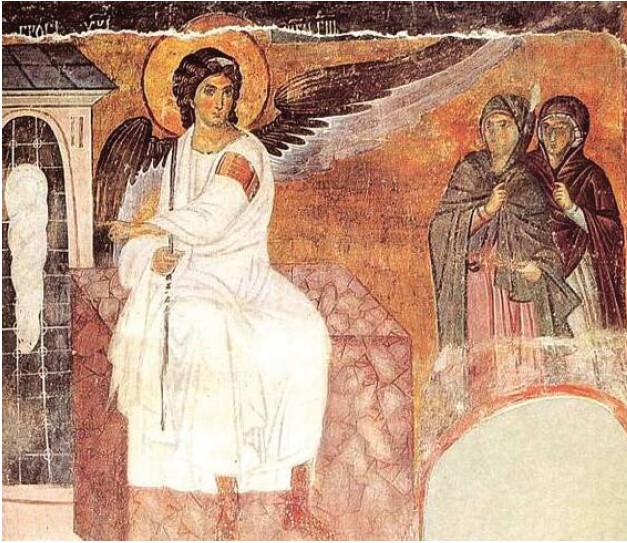
For the culture of ancient Serbs, it does not matter at all whether the Americans sent the most beautiful fresco in the world—the White Angel from Mileševa— into space, for the only ones at a loss are aliens.
Something divine helped the man-made. Some inexplicable and invisible power made it so that the frescos depicting the Nemanjićs and the White Angel, in the monastery Mileševa near Prijepolje, survive so many centuries.
The exterior of the Church of the Ascension of Christ in the monastery Mileševa gives no indication as to the priceless beauty of its interior. When the Serbian king Vladislav Nemanjić erected this church as his endowment in 1219, one or many anonymous artists educated in Constantinople, Nicaea, and Thessaloniki painted frescoes of incredible beauty on golden surfaces. It was the golden age of the celebrated Nemanjićs.
The light plays with the raised depictions of the founder of the dynasty, Stefan Nemanja; his sons Saint Sava and Stefan Dečanski; the young prices Radoslav and Vladislav the ktitor, or patron; on the faces of Christ and his mother Mary, giving them natural halos.
In that play of light, the White Angel seems to have separated from the wall and is floating in the air, so pure and noble that he looks at everyone straight in the eyes. And wherever you might move—left or right, stand or kneel, cry or pray—the White Angel will look you in the eyes. That is the marvel of this fresco.
Everything shone of gold and sunlight in this church of the Nemanjićs in that 13th century, and at night when the candles and cressets were lit, a new light flew over the gold leaf on the walls and the golden frames and icons decorated with precious gemstones and rock crystal.
Eight hundred years have flown by since this scene at Mileševa. Many icons would disappear without a trace, and the goldleaf on the frescos in the monastery Mileševa would dry up and fall off. However, the White Angel— a fresco of incredible beauty and power— would remain untouched; as if time itself, which wears everything down and turns it into dust, stopped in front of it, enraptured by its beauty.
Before the unknown artists from Mileševa, nobody painted with such style and passion. For this reason, the French 20th century art historian Tania Velmans believed that the renaissance of art began in Mileševa, significantly before the Italian masters of the Renaissance.
The famous British archeologist, Sir Arthur Evans, who saw much ancient beauty in his studies of Minoan culture, was fascinated by the White Angel. In 1883, he would write in the Manchester Guardian that nothing Giotto created could be compared with the beauty of the White Angel from the royal Serbian endowment, the monastery Mileševa.
The fresco of the White Angel that floats and looks everyone in the eye is in fact part of the composition The myrrhbearers at Christ’s tomb. It depicts the archangel Gabriel, dressed in a white chiton—not an everyday outfit for an angel—sitting on a stone and indicating with his hand to some nearby women the place of Christ’s resurrection; his empty tomb. As he is depicted here as the herald of Christ’s resurrection—the fundamental belief of Christians— the fresco has become a synonym for hope, salvation of the soul, and miracles in general.
Our angel with the secretive look even received the relics of Saint Sava in 1237, brought to Mileševa from Tarnovo by his nephew, Kind Vladislav, with the help of his wife, Bulgarian princess Queen Beloslava.
Then, in the 16th century, it was covered by another fresco. The saintly White Angel disappeared under the layers of a new fresco that was painted on top. Thus, hidden in the bosom of another composition, it would wait another 400 years before being discovered, rising once again from the fire.
A fire that damaged Mileševa in the 19th century removed a layer from the frescos which led to the discovery of the White Angel underneath. Thus, the White Angel—the fresco for which Bishop Nikolaj Velimirović said that even looking at it was akin to a prayer—was reborn.
Europe would see the beauty of medieval Serbian art in 1947, when the Council for Science and Culture of the Federal People’s Republic of Yugoslavia—in collaboration with professional copyists from France—organized the copying of medieval Serbian art. In 1950, in the Palais de Chaillot in Paris, 160 copies of frescos and 105 sculpture casts were exhibited. Among them was the White Angel, the pinnacle of art.
From then on, the White Angel (in copy form) would travel the world as the supreme example of medieval Serbian art. When the first public broadcast video signal was established between Europe and the Americas via the Telstar satellite on June 23rd, 1962, what was shown was Miroslav’s Gospel and the White Angel.
At that time, televisions distorted and muddled pictures, and in recent years, there would appear the muddled and sensational claims that the Americans did not, in fact, include the White Angel on their disk containing prime examples of human civilization that they sent into space. For the culture of ancient Serbs, this does not matter at all: even if it was not sent, the only ones at a loss are aliens that will not be able to see the beauty of the White Angel.
The Angel in Florence:
The White Angel has permanently settled in Florence since 2012. It is on permanent display in the largest Franciscan church in the world, the Florentine Basilica of Santa Croce, where one can otherwise find the tombs of Michelangelo and Galileo beside works of Giotto, Leonardo da Vinci, and others. Prominently displayed there is also a reproduction of the White Angel. Millions of people from around the world enjoy the beauty of our White Angel.
Upcoming Events
Article Categories
- DIARY OF THE IMMIGRANT
- HIGHLIGHTS
- Editor's Note
- Trending
- Interview
- INTERVIEW: COFFEE WITH
- Canada
- Serbian Community
- Serbs Around the World
- Homeland
- Visit Serbia
- Life Today
- History and Traditions
- Through the Prism
- Business & Career & Finances
- New Destinations
- Arts & Culture
- Nurturing Serbian Language
- ABCs of Health
- Our Kitchen
- Diary of a Serbophile
- Sports and Hobbies
- Young Journalists
- Kids’ Page
- Our Youth
Fundraising Campaign for SAN
With your donation, you will contribute to the continued existence of the magazine as well as the maintenance of the website. Your name or company name will be included on our page “Our Sponsors”. If you wish you may also choose to remain anonymous (be sure to select the option to donate anonymously in the application). Thank you for considering to support SAN.
Donate Now