
The Folk and Ecclesiastical Customs of the Serbs During Easter
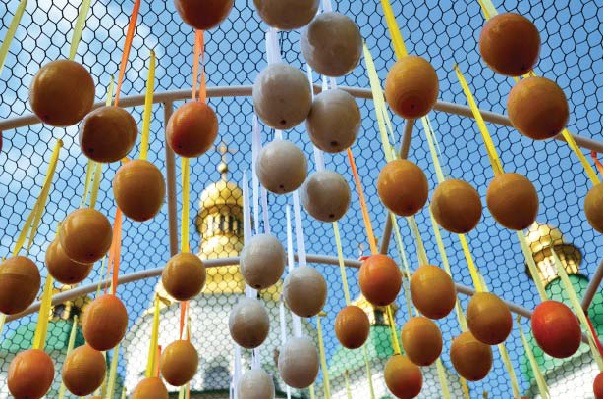
Easter is the most important Christian holiday. On that day, the Lord Jesus Christ defeated death and was resurrected, giving eternal life to everyone on the earth, from first to last.
Easter is a Spring holiday which falls on different days each year, somewhere between the 4th of April and the 8th of May as per the Gregorian calendar. However, the significance of this holiday is so great, that the Sunday of every week represents a little Easter.
Based on the way in which Easter is celebrated, we can recognize that some elements have been taken from polytheistic faiths which pertain to newly reborn nature and its resurrection from the sleep of winter. Still, the greater part of the customs surrounding Easter are steeped in ecclesiastical elements which celebrate and hold in remembrance the death and resurrection of Christ.
The custom of giving eggs is associated with Easter throughout the entire Christian world. The egg is a symbol of the renewal of nature and life, and the red Easter egg signifies the joy of whoever gives it and whoever receives it. The red colour symbolizes the innocent blood of Jesus Christ which was spilt, yet it is simultaneously the colour of the resurrection.
The custom of family egg colouring is one of the most joyous, and one which children are especially endeared to. Easter eggs are pained on Good Friday, the day which marks the occasion of Christ’s crucifixion. In the afternoon a shroud (a cloth upon which the laying of Christ into the tomb is depicted) is carried out of the church, and the faithful come to kiss this shroud until Easter. In some regions, it is customary for the faithful to pass under a table on which the shroud is laid out on and, praying to God, they make a wish. Good Friday is a day of fasting, with no consumption of fish or oil.
The children of the family usually participate in the egg colouring. A small amount of holy water is placed in a pot of regular water. The first coloured egg is laid aside, and kept until next Easter. That egg is called the “guardian of the home.” The eggs can be decorated in numerous ways, with the oldest method being to dip a goose feather into melted wax, with which crosses and other religious symbols would be drawn on the egg. Patterns can also be made with small leaves and grasses which are tightly fastened to the egg shell, and submerged altogether in the water. Such decorations stem from the pre-Christian cult of nature, specifically its resurrection and the renewal of life from the earth. Today, eggs are more frequently coloured with onion skins, with patterns made through the use of foil, elastic bands, stickers, or the decoupage technique.
As with other holidays, folk customs vary from place to place between Orthodox Serbs. However, ecclesiastical customs are identical everywhere.
It is considered proper to get up early and go to bed early on Easter.
The hostess prepares the water for face washing. One’s face is washed on Easter with fresh and untouched water in which a red-coloured egg, basil, European cornel, and geranium were previously placed. One’s cheeks are rubbed with the egg, for health. In some places the egg that is used here is the “guardian of the home.”
All members of the household go to church and are present at the Easter liturgy. After the service, everyone greets each other with “Christ has risen” and “Truly, he has risen.” This is the greeting which is used up to the Feast of the Ascension.
In many homes the head of the household lights a candle, censes the members of the household with smoke, sings a troparion, if he can, and reads “Our Father” before everyone seats themselves at the table. First the Easter eggs are eaten, then the rest of the meal.
Each visitor is given a red egg.
Both children and adults “fight” with their eggs.
In some places, the “guardian of the home” is buried in the field along with the crops in order to protect them.
In other places, taking painted Easter eggs to the graves of ancestors is still considered customary.
Bread is prepared for Easter. In the region of Syrmia, this bread is called “buzdovan” (Morning Star), and in Šumadija it is known as “vitica” (wreath). An egg is placed inside the bread and baked along with it. The bread is broken during lunch and the head of the household proclaims: “Everything has risen (come to life) and been resurrected!”
It is considered improper to sleep on Easter, so that we might not be lazy throughout the year.
It is also believed that the soul of whoever dies on Easter would go to Paradise, since the gates of Heaven are open on this holiday.
The first Monday after Easter (Pobusani ponedeljak) is dedicated to the dead. The national custom is to sod the graves of deceased family members with fresh green grass. This is also when the remaining painted eggs are taken to the cemetery, and afterwards distributed among the poor.
In certain regions, desserts and eggs are hidden around the house and property for children to find. The hunt begins right after Easter breakfast. The custom of giving desserts and other gifts to children on Easter is more recent.
Upcoming Events
Article Categories
- DIARY OF THE IMMIGRANT
- HIGHLIGHTS
- Editor's Note
- Trending
- Interview
- INTERVIEW: COFFEE WITH
- Canada
- Serbian Community
- Serbs Around the World
- Homeland
- Visit Serbia
- Life Today
- History and Traditions
- Through the Prism
- Business & Career & Finances
- New Destinations
- Arts & Culture
- Nurturing Serbian Language
- ABCs of Health
- Our Kitchen
- Diary of a Serbophile
- Sports and Hobbies
- Young Journalists
- Kids’ Page
- Our Youth
Fundraising Campaign for SAN
With your donation, you will contribute to the continued existence of the magazine as well as the maintenance of the website. Your name or company name will be included on our page “Our Sponsors”. If you wish you may also choose to remain anonymous (be sure to select the option to donate anonymously in the application). Thank you for considering to support SAN.
Donate Now