
“Saint Sava the Serb” Exhibit
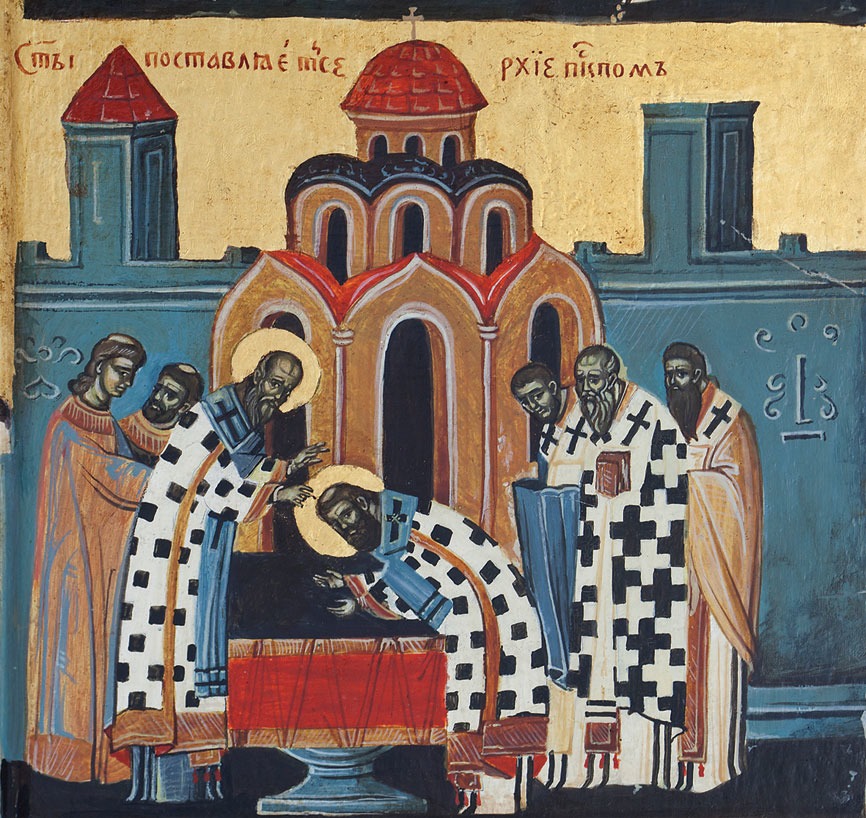
Monk, theologian, diplomat, enlightener, orator, writer, legislator, statesman, and the first Archbishop of the independent, autocephalous Serbian Church. All of Saint Sava’s roles are depicted in the recently opened “Saint Sava the Serb” exhibit, at the Historical Museum of Serbia. The exhibit was ceremoniously opened by His Holiness the Serbian Patriarch Irinej. The exhibit was curated by Dr. Andreja Vujnović, and the designs and arrangements were created by Rastko Šurdić. The exhibit was realized thanks to the patronage of the Republic of Serbia’s Ministry of Culture and Information, and will be open until November 28th, 2016.
The “Saint Sava the Serb” exhibit is the result of many years of research by its curator. It depicts items which pertain to Saint Sava such as archival materials, copies of frescoes and icons, photographs of personal items, and relics, in order to unveil a more complete picture of his sacred and spiritual path to the public, as well as his greatness and significance for not only the Serbian nation, the Orthodox church, but also Serbian history and culture as a whole.
The exhibit depicts the temporal life of Rastko, the third son of the Grand Prince of Raška, Stefan Nemanja, the renunciation of his position of leadership, his departure for Mount Athos, his induction into the order of monks under the name of Sava, and his work to achieve an autocephalous and autonomous state for the Serbian Orthodox Church in Nicaea, where he became the first Serbian Archbishop.
His efforts towards improving the ecclesiastic organization, his accomplishments in state development and diplomacy, especially in achieving an international acknowledgment for the Kingdom of Serbia, as well as his immeasurable, multi-faceted contributions to the fields of enlightenment, literacy, and altruism (the renewal of the Hilandar monastery, the construction of Žiče, Studenica, and other monasteries), all served to make Saint Sava the most significant figure in the history of the Serbian people.
Due to his deeds, Saint Sava was considered a Saint within his lifetime, but his cult was only solidified after his death in 1236 at Tarnovo in Bulgaria, and the transportation of his remains to the Mileševa monastery. Since then, he has been esteemed and respected among the Russians, Greeks, Bulgarians, and many other people in the surrounding regions. In 1594, one hundred and a half years after the founding of Serbia, the Turks realized that the cult of Saint Sava meant a cult of “the old Serbian kingdom” which the people wanted to renew. And so they burnt the Saint’s remains in Belgrade.
The Most Intriguing Items: The Scepter and the Remains
Aside from Saint Sava’s left hand, which was miraculously saved from the burning on the Vračar plateau in 1594, the treasury of the Mileševa monastery also houses a staff – the sceptre of Saint Sava, which is believed to possess miraculous powers. The Saint received this sceptre as a gift from the patriarchy of Jerusalem, when he was appointed the first Archbishop of the autocephalous Serbian Church in 1219. The monks later decorated the sceptre, and besides a crystal apple on its tip, it is entirely covered in silver bearing an inscribed troparion to the Saint. A group of other relics surrounds the original sarcophagus in which Sava’s body was laid to rest in the Mileševa monastery.
Vojislav Ilić: Saint Sava
Who knocks so late in the quiet depths of the night
On the closed gate of the monastery, set atop the Holy Mountain?
“Long since has the dim evening gone, and the silent midnight creeps upon us,
Grey-haired fathers, monks, open for me these heavy doors.
My soul yearns for light, my weak legs need rest,
My body withers, my legs tired –
But it is a bold will, that tonight leads me to come
And dedicate my life to my lineage, my ancestors, and my freedom.
I have grown tired of regal palaces, royal crowns, and regal cloaks,
And now, thus, do I seek the light in a humble monastery.
Honorable fathers, open the heavy doors of the monastery,
And accept the son of a king, as if he were the youngest of your brothers…”
The heavy gates creaked open as an owl fluttered overhead,
Spreading its wings with a screech, and disappearing into the black night.
And at the doorstep of the holy temple, where the name of God is celebrated,
The abbot answers holding a torch alight.
Raising the flame, above his holy head,
He peers, amazed, at the harmless, barefoot child.
High is his pale brow, and ruffled is his thick mane,
Yet a high brow, is the crowning mark of divine wisdom.
The elder takes him by the hand, kisses his pale brow,
Whispering through tears: “We accept you, my dear child.”
Centuries have whirled by, since that most miraculous night –
Centuries have whirled by, and many more will come and go –
But yet does that child live, since yet his glory survives,
Since that child was Rastko, the son of Nemanja, the Saint Sava.
Upcoming Events
Article Categories
- DIARY OF THE IMMIGRANT
- HIGHLIGHTS
- Editor's Note
- Trending
- Interview
- INTERVIEW: COFFEE WITH
- Canada
- Serbian Community
- Serbs Around the World
- Homeland
- Visit Serbia
- Life Today
- History and Traditions
- Through the Prism
- Business & Career & Finances
- New Destinations
- Arts & Culture
- Nurturing Serbian Language
- ABCs of Health
- Our Kitchen
- Diary of a Serbophile
- Sports and Hobbies
- Young Journalists
- Kids’ Page
- Our Youth
Fundraising Campaign for SAN
With your donation, you will contribute to the continued existence of the magazine as well as the maintenance of the website. Your name or company name will be included on our page “Our Sponsors”. If you wish you may also choose to remain anonymous (be sure to select the option to donate anonymously in the application). Thank you for considering to support SAN.
Donate Now