
Interview with Maja Herman Sekulić

At the beginning of February of this year, in the consulate of the Republic of Serbia in Toronto, we presented two books of Maja Herman Sekulić, who came to visit from New York. Poet, writer, instructor, and translator, Maja Herman Sekulić studied undergraduate and master’s degrees in World Literature at the Faculty of Philology in her native Belgrade. She received a doctorate from Princeton University (USA), where she also taught as well as at Harvard and Columbia. She is a member of the Association of Writers of Serbia, the Serbian Literary Society, both the Serbian and the American PEN Centres, and the Poetry Society of America. She has published collections of poetry, novels, critiques, essays, reviews, forewords, and major translations and critical editions of works by world-class authors.
I knew about Maja Herman Sekulić principally as an exceptional poet and essayist, and on this occasion I personally met with the author and asked her a few questions, which she happily answered.
SAN: You came to America as a student, and later as a doctoral student on the invitation of graduate schools, and you received the most prestigious awards including two Fulbright scholarships. Tell us a bit about that.
-
Yes. I came to America for the first time as an undergraduate student to Hope College—a private institution in Michigan—for only a year, then I returned to Belgrade to graduate, and later I returned to America as a doctoral student at Princeton, where I graduated in 1986 as the first Serbian woman thus far.
SAN: Did you ever feel like an emigrant?
-
Since I was little, I was educated abroad from time to time and always felt like a citizen of the world, so the arrival to America did not feel like a big shift. Before and after that, I lived in different countries. I lived on three different continents in the 1990s. I specifically came to the US in search of higher knowledge, and not out of necessity or as a political asylum seeker, and for that reason—as I was taught by our great genius Mihajlo Pupin—I cannot feel like an emigrant! Maybe, as a writer and intellectual, I am in some kind of voluntary exile, like the majority of modern writers. However, I never left my homeland, rather my homeland left me. But luckily my Belgrade is still holding on, and it is always in me and I always return to it. Now I spend my time between New York and Belgrade.
SAN: Which of your books was most successful with the American and worldwide public? I heard that it was possible to buy your book The Jade Window (Prozor u žadu) in Angkor Wat, the largest religious building in the world, in Cambodia.
-
I am above all a Serbian author, but I do write and publish in English—today’s lingua franca—and in the United States, although it is the toughest market. Last summer, I released an electronic edition of Tesla’s biography, which is supposed to be some kind of introduction and textbook for American schools. So, I can write essays and prose in English without any particular problems, since I learned to write in English at four years of age; that is, before going to Serbian school, I went to an English school. With poetry, it is a different story. I’ve spoken about this many times with my dear friend Joseph Brodsky who shared the same fate as a writer who writes in two languages. I believe that the greatest exposure I have received in the U.S. and the world has come from some very respected American journals that have published my poems and essays, particularly about Joyce; last summer, one lovely French writer published his selection of my poems in English and French; my novel The Silk King (Kralj svile) and The Jade Window, my travelogue around Southeast Asia where I lived during the 1990s, both came out in English and have enjoyed immense popularity in those far-off countries.
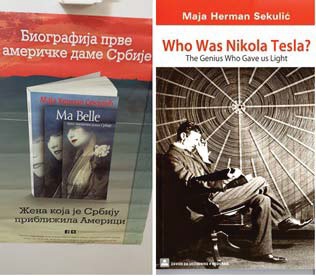
SAN: How did the idea come to you for “Who was Nikola Tesla? The Genius Who Gave Us Light,” and what kind of reception are you expecting for it?
-
The book came to light as I responded to a call from The Tesla Science Foundation to write something for their conference in New York at the start of 2015. I never dreamed that I would write about a scientist, although I always had a secret bond with science, since my cousin Bogdan Maglić is a well-known scientist, and at Princeton—which is the most important centre for theoretical physics in the world—all my best friends were in fact physicists. I did not plan anything until I read on the invitation that the theme of the conference was “How to introduce Tesla’s curriculum to American high schools.” That was my starting inspiration. At the beginning, I was writing the book like a textbook, and then it turned into a text for everyone aged 12 to 112 who was not an expert and who wanted to learn more actual proven facts about Tesla, and not fiction and unproved speculations. My title is therefore both the simplest, and also provocative: “Who was Nikola Tesla?” I was completely devoted to that material, since you cannot do any differently when dealing with Tesla. In the meantime, word got out, and I began to be contacted by pseudo-experts and quacks who had various suggestions on what should go in the book. Everything that I found suspicious, I checked with the long-time director of Tesla’s museum and several top physicists at Princeton. I had no pretension to write a technical book, but rather a reliable biography. I wanted to write non-fiction to counter all the novels and fiction books and half-truths about Tesla. That is probably why I got the direct support of the Nikola Tesla Museum in Belgrade, the main arbitrator of the truth about Tesla. It has been difficult to break through to American schools, however we are doing it slowly but surely.
SAN: Your second book, which you presented to the public in Toronto, is the novel Ma Belle and is the story of the life of Mabel Dunlop Gordon Grujić, one of the greatest Serbian benefactors, but of whom we know very little. How did you come to the idea to write about Mabel Grujić, and was it difficult to uncover information about her life?
-
I am a close friend of the Grujić family—that is, the successors of Mabel Grujić—so I knew some things about her to begin with, but then in the Princeton manuscript library I found entire boxes full of correspondences between Mabel Grujić and Hamilton Fish Armstrong, the famous American journalist, politician and founder of Foreign Affairs; a correspondence which lasted more than 50 years! I dedicated myself to that research for almost five years—I could have written a whole other doctoral dissertation—but I did not want to overload the book with footnotes and historical material, but rather to create an artistic synthesis that would bring the character of this noble woman closer to a wider audience.
After so many years of Serbia being represented in the worst possible light in the worldwide media, I felt the need to lift everyone’s ego and remind them of a time when the Serbian flag was flaunted above the White House. The action takes place during a time of bubbling in Europe and the Balkans at the beginning of the twentieth century, when this noble woman was operating in Serbia; an American woman from high society who along with her husband, diplomat Slavko Grujić, held lectures about Serbian epic poetry all around America and was collecting aid for Serbia in the period between the Balkan Wars and the First World War, throughout the latter, and through to the end of the Second World War.
SAN: Can anything more be done right now on the plane of literature to raise the interest in and reputation of Serbia in the United States?
-
I have been working on that for a long time with my books, and with important translations into both languages. Both of my new books—which coincidentally came out one after the other—deal with that question on the highest level: the interaction of the American and Serbian elite.
SAN: In New York, was it the same to say that you were from Serbia twenty years ago as it is today?
-
In New York, at least among regular people, mostly people do not even know where Serbia is, nor do they care very much. New York is like a jump-rope spinning very fast, and you either jump in on time, of you do not. In terms of American institutions and the press, all of it made me sick in the 1990s during the war in the Balkans. The New York Times even today has an anti-Serbian filter in the news, and when I wrote a purely humanistic text (something similar to my Lament for Belgrade) during the embargo and bombing of Belgrade, they did not want to publish it, but they did publish the text of a colleague of mine from Zagreb. So I published that text in Japan. When I was complaining about this to Charles Simić, he told me that “we did not have the right to vote,” and that they shortened even his text [Letter from Charles Simić to the New York Times, entitled “Serbia vs. the New World Order,” Aug. 21, 1991 – annotation by SAN] although at that moment he was the United States Poet Laureate. The same thing happened to me when I was a visiting Fulbright scholar at Rutgers University: I was not invited to a conference about Balkan literature, where there was not a single representative from Belgrade or from Serbia. Or one time when an American poet invited me to give a talk at Woodstock right before the breakup of Yugoslavia, and he was attacked by people who disagreed with that. Things are not so vicious anymore, but I still have a bitter taste in my mouth.
- SAN: Do you socialize with the newer Serbian emigrants in New York?
-
Serbian emigrants in New York are not a particularly homogeneous group, as they are in Toronto or in smaller places or towns outside of New York. And now, there is not even one particular meeting place, at least in terms of cultural events, like there once existed the Yugoslav Cultural Center. That role has been taken over primarily by the church and to some extent by the consulate.
Cultural events of greater importance are rare and sporadic. There are a few artists who are important on a worldwide scale, but I would sort neither them nor myself into the category of emigrants—old or new—since they were important in the world before ever coming here.
SAN: Was the 1980s American poetry scene more exciting than today? In your book Skice za portrete (Sketches for Portraits) you published essays and conversations with the biggest names of the day: Joseph Brodsky, Charles Simić, Harold Bloom, Saul Bellow, Allen Ginsberg…
-
I experienced the 1980s New York poetry scene firsthand, since some of the leading poets were my close friends, which is the topic of my book of essays and conversations Sketches for Portraits, which you know and which I hope will come out soon in my Selected Works, along with some of my other books which are long sold out or out of print. I spent the 1990s more in the Far East than in New York, and in the new millennium many of the writers from the book had already disappeared forever. Just recently, one of those closest to me died: Mark Strand, also a United States Poet Laureate, a great friend, connoisseur of poetry, and one of the most attractive men on the planet. I am still on top of the goings-on in the scene, but the climate of everything has changed in this new century, including in poetry.
SAN: What connects you to the homeland in this moment?
-
My homeland is in my language, as my friend Brodsky used to say. Besides my language and my hometown, eternal Belgrade, my books and my wonderful friends keep me connected.
SAN: Is a harmonious private life important for a woman intellectual, and do you think that marriage has a future?
-
I think that a harmonious private life is important for everyone, because it is good to have a partner in one’s life who is compatible, but I think that it is equally important to maintain one’s independence. At least for me, it is vitally important. It is a question of delicate balance and mutual respect, which is crucial for maintaining any relationship, and that differs from individual to individual. There are no specific rules.
SAN: You have traveled the world and lived on a few different continents with your husband, renown architect Miloš Sekulić. Which travels to do you remember most fondly?
-
That is difficult for me to decide. I always tried to not be a tourist. I love big cities; cities are my nature, like in the case of Woody Allen. The most beautiful city for me is Venice. Besides New York and Belgrade, where I live, the cities closest to me are Paris and Bangkok, where I also spent some formative years. In terms of pure aesthetics, the most aesthetic is Kyoto. I had the privilege to travel all around Japan on a few occasions, and to slowly, leisurely travel through all of Southeast Asia; to get to know all of its tastes and smells, which have little by little seeped into my travelogues and poetry.
Upcoming Events
Article Categories
- DIARY OF THE IMMIGRANT
- HIGHLIGHTS
- Editor's Note
- Trending
- Interview
- INTERVIEW: COFFEE WITH
- Canada
- Serbian Community
- Serbs Around the World
- Homeland
- Visit Serbia
- Life Today
- History and Traditions
- Through the Prism
- Business & Career & Finances
- New Destinations
- Arts & Culture
- Nurturing Serbian Language
- ABCs of Health
- Our Kitchen
- Diary of a Serbophile
- Sports and Hobbies
- Young Journalists
- Kids’ Page
- Our Youth
Fundraising Campaign for SAN
With your donation, you will contribute to the continued existence of the magazine as well as the maintenance of the website. Your name or company name will be included on our page “Our Sponsors”. If you wish you may also choose to remain anonymous (be sure to select the option to donate anonymously in the application). Thank you for considering to support SAN.
Donate Now