
Interview with His Royal Highness Crown Prince Alexander
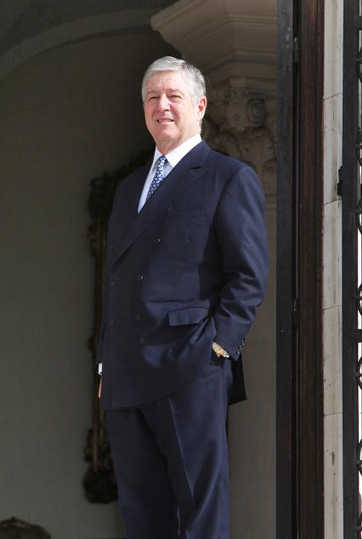
SAN: My generation, which grew up in Yugoslavia, was first introduced to you through an interview of yours published by the Slovenian magazine, Mladina, which was later picked up by other Yugoslavian media outlets in 1988. In that renowned interview, from so many years ago, you were of the opinion that the only way for the then-unified Yugoslavia to economically recover and progress was through democratization and joining the European Union. How do you view this today? Is Europe still the only option for Serbia?
HRH Crown Prince Alexander:
I believe that development of events has confirmed that I was right. But, as you see, my formula was democratization first, and accession second. Secondly, it’s not the same if a country with a population over 20 million starts accession negotiations, or fragmented federal units that individually have no strength to resist complete assimilation, economic assimilation in the first place. Take Slovenia for example, which was economically most progressive in ex-Yugoslavia. Today all the economy that exists on its territory is owned by the foreigners. Slovenians may have jobs, but foreigners have the profit. In comparison to current situation, the objections they had to former Yugoslavia seam truly harmless.
SAN: What political climate could enable the introduction of a constitutional monarchy in Serbia? What benefits would Serbia gain from a monarchical structure?
HRH Crown Prince Alexander:
Let’s exclude all the speculative advantages of restoring monarchy in Serbia, it would be beyond doubt a comparative advantage in regard to other countries in the region, advantage in view of creating country’s brand. I am sure that it would gain lot of attention, and I don’t even exclude the possibility that the others could follow our example. In order to make that happen, it takes a ruler with a vision, someone who by some ideas reminds of the president Macron, Franco, maybe even Apis. The main political advantage would be that Serbia would have had a politically neutral head of the state.
SAN: You visited Serbia for the first time in 1991 and have lived there since 2000. What pleasantly surprised you in the land of your ancestors and, conversely, what were the biggest difficulties you encountered in the new social milieu?
HRH Crown Prince Alexander:
What struck me was the incredible hospitality and welcome that my wife and the boys received. We travelled all around Serbia and also Republika Srpska and we were always warmly received by every single municipality regardless of political party. The beauty of our country was very prominent. In addition, the historical places we saw was wonderful.
With respect to difficulties was the tragedy our people went through and the tough living conditions. Poverty was very prominent, the tremendous lack of jobs, plus the troubles of health care and pensions. The infrastructure was in an horrendous situation. My wife opened her foundation office as soon as we came to live in Serbia in August 2001 and set upon helping everyone with humanitarian deliveries.
SAN: Can you tell us more about your life and career before your move to the Balkans? In what way were you exposed to our language and culture in your childhood and youth?
HRH Crown Prince Alexander:
I always had to work to earn my living in the United Kingdom, Brazil and the United States. There were no trains filled with gold or bank accounts. I continued the family military tradition like my great grandfather King Peter I who went to Saint Cyr the famous French Military Academy and my grandfather King Alexander who went to the Corps Pages in Saint Petersburg. I went to the British Military Academy. Then I went into business: advertising, insurance and finance. My father King Peter II was very good to me and told me about our history and culture. I did have Serbian lessons when I was at school in Switzerland then the United States. I really thought there would be no end to the dictatorship in our country and so I concentrated on my work, but always followed events in the former Yugoslavia.
SAN: It appears that the Serbia of your grandfather, King Alexander I, Serbia at the start of the 20th century, had far more sovereignty than the Serbia of today, how would you account for this?
HRH Crown Prince Alexander:
Serbia always paid dearly its sovereignty. Periods of its true sovereignty unfortunately did not last long, butthis has always been the first item on the list of its national interests. Even when sovereignty was in jeopardy or distant, the continuous aspiration existed and a plan on how to achieve it. Not all the problems are meant for one generation to resolve them, but it’s also very dangerous if one generation ruins all that the previous ones have done.
SAN: Your father, King Peter II, the final Serbian and Yugoslavian monarch, was accused by both communists and royalists for conspiring and sympathizing with the other side. Where, for you, does the truth lie?
HRH Crown Prince Alexander:
I strongly suggest you read the memoirs of my father. Communist propaganda is one thing and the facts are the other.
SAN: How did he grow out of favour with Churchill?
HRH Crown Prince Alexander:
The British say that there are no permanent alliances, but only permanent interests. The fact that a certain politician is nice to you in communication doesn’t mean that his intentions are good, too. Yugoslavia was unfortunately sacrificed at the Tehran conference in 1943, everything else was a tedious performance.
SAN: In 2013 you organized for your father’s remains to be taken from the Monastery of St. Sava in Libertyville, to a family grave in Oplenac. You have mentioned that this was his greatest wish, to be laid to rest in the fatherland. How strong were his ties to the people and the land, truly, especially considering that he lost his father, the throne, and the state so early and in such tragic circumstances? What had he told you about Yugoslavia?
HRH Crown Prince Alexander:
The last sentence in my father’s memoirs is: I have dedicated this book to the brave people of Yugoslavia who is always on my mind; brave people, uncomplying people, hardworking people, impetuous, proud, bright, undisciplined, but with a heart of gold. People with a great future ahead. It lives in a small European country, the richest one in the continent; country of an indescribable beauty, diverse climate, rich fertile land and immense mineral wealth; of huge impenetrable forests, fast streams, big navigable rivers and marvelous Adriatic Sea. That’s my people. That’s my country.
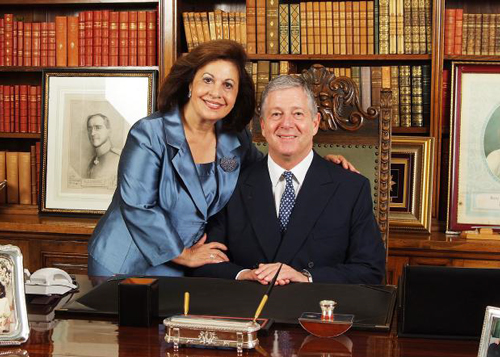
SAN: What can you tell us about the Greek side of your family? Your mother, Princess Alexandra, was the daughter of a Greek king. What would you consider yournative language, did you ever speak Greek with her? And, finally, do you see a future in creating stronger tiesbetween Greece and the other Balkan countries?
HRH Crown Prince Alexander:
My mother was the daughter of King Alexander of the Hellenes and Aspasia Manos. My mother spoke English and French with my father. My native language would be Serbian, but I was declared an enemy of the state at the ripe age of two (see attached documents) and I was denied to live in the country of my ancestors. What a disgusting thing to do, a terrible violation of human rights.Our country has always been close with Greece like brothers and sisters. In addition, Greece was very good to us during our troubles. I believe we should work on closer ties with countries in region since we need each to survive economically specially to create jobs. Only foolish people will work against friendship with our neighbors.
SAN: The humanitarian work which your wife, Princess Katherine, has devoted herself to is impressive. Her organization, Lifeline, primarily assists hospitals, orphanages, and disadvantaged groups in society. In what cities, other than Belgrade, Toronto, and Chicago, are there divisions of Lifeline, and can you tell us what future plans might be in store for this organization?
HRH Crown Prince Alexander:
I am very proud of my wife’s humanitarian hard work. Other than Belgrade, Toronto and Chicago, Lifeline offices are operating in New York, London and Athens.As far as humanitarian work is concerned, the Foundation of Crown Princess Katherine is currently concentrating on the education of our doctors and replacing old medical equipment for new ones. Only during the last one year, we brought more than 2 million dollars in new medical equipment for medical institutions across Serbia. It is very important to involve the Serbian Diaspora in everything, and to remind them that this is their homeland. Many of them have been helping Lifeline offices, in Chicago for nearly 25 years, which will be marked in 2018.
SAN: Congratulations, your first, of three sons, has married, and you now have a beautiful and talented daughter-in-law, Danica Marinković. She is an artist, and has also grown up outside of Serbia, just like your son Philip. Where was the wedding held? Where will the newlyweds live? Now, in the 21st century, is there a normalized trend for princes to marry women who are not necessarily of a royal lineage themselves?
HRH Crown Prince Alexander:
Thank you very much. Philip and Danica were married at Saborna Church in Belgrade on 7 October 2017. The wedding was officiated by His Holiness Serbian Patriarch Irinej of Serbia. The Godmother was HRH Crown Princess Victoria of Sweden and Godfather was His Royal Highness Hereditary Prince Peter. The wedding was truly beautiful, and we were delighted that Her Majesty Queen Sophia of Spain and Her Royal Highness Crown Princess Victoria of Sweden came especially for the wedding.Of course, we were even more happy when, on February 25, our grandson Stefan was born. This male birth is the first one in the Royal Family in Serbia for 90 years when HRH Prince Tomislav was born in Belgrade. Philip and Danica are currently living in Belgrade and London, but my and their wish is to settle in Belgrade where Stefan was born.
SAN: Here in Canada, we live in a multicultural society, and it is our wish that the Serbian ethnic identity be maintained in diaspora. In your opinion, what are the most valuable characteristics of our people and our heritage, and what makes us unique in relation to other nations?
HRH Crown Prince Alexander:
The most valuable characteristics of Serbian people are courage, wisdom, dignity and persistence. On the other hand, we often forget things very fast, which is not good. Something which is unique for Serbian people, comparing to the other nations, are our adaptability to anything and anyone. Our sense of humour as well.
SAN would like to thank you for this exclusive interview for our magazine.
Upcoming Events
Article Categories
- DIARY OF THE IMMIGRANT
- HIGHLIGHTS
- Editor's Note
- Trending
- Interview
- INTERVIEW: COFFEE WITH
- Canada
- Serbian Community
- Serbs Around the World
- Homeland
- Visit Serbia
- Life Today
- History and Traditions
- Through the Prism
- Business & Career & Finances
- New Destinations
- Arts & Culture
- Nurturing Serbian Language
- ABCs of Health
- Our Kitchen
- Diary of a Serbophile
- Sports and Hobbies
- Young Journalists
- Kids’ Page
- Our Youth
Fundraising Campaign for SAN
With your donation, you will contribute to the continued existence of the magazine as well as the maintenance of the website. Your name or company name will be included on our page “Our Sponsors”. If you wish you may also choose to remain anonymous (be sure to select the option to donate anonymously in the application). Thank you for considering to support SAN.
Donate Now