
Interview with Miloš R. Popović, Professor at the University of Toronto
SAN: Miloš, you graduated from the Faculty of Electrical Engineering at the University of Belgrade in 1990, receiving your PhD in Mechanical Engineering in Toronto. Today you work with functional electrical stimulation, neurorehabilitation, neuroprosthetics, the connections between the human brain and machines, modeling and controlling linear and non-linear dynamic systems, and robotics. What was the transition from electrical and mechanical engineering to biomedical engineering like? Where did your interest in neuroprosthetics and neurorehabilitation come from?
I began my career with systems of producing electrical energy. After that I moved to robotics, and I also worked in the aviation industry. I began to develop neuroprosthetics and involve myself in neurorehabilitation only afterwards, around 1997. That career transition was neither anticipated, nor obvious.
Dr. Dejan Popović, a professor and academic from the Faculty of Electrical Engineering in Belgrade was responsible for this career change. Professor Popović is an internationally renowned and respected expert in these fields. Through his contacts he discovered that the Swiss Federal Institute of Technology in Zurich (ETH Zurich) was seeking to fill a position for a young scientist who would work in the development of neuroprosthetics. At the time that he contacted me and made me aware of the position (1996-1997) I was not quite interested in switching jobs, since my career in the aviation industry was coming along well. Luckily, I was smart enough to listen to Professor Popović’s advice, and left for an interview in Zurich. As a result, I began working at ETH Zurich in 1997.
SAN: You have been involved in biomedical engineering since 1997. Would you say that you are professionally satisfied?
Another vital element that contributed to my complete devotion to neuroprosthetics is the knowledge that this subject is much more complex than robotics or the development of aviation systems. When you create a system that assists someone who is paralyzed, you immediately have the opportunity to see how your device improves the life of the patient. I have the impression that my first encounter with a patient and what we were able to achieve for them was decisive in quickly devoting me to the development of neuroprosthetics and neurorehabilitation. Since I have been involved in neurorehabilitation, not once have I wished to change my field or job.
SAN: You are one of the founders of the Canadian National Spinal Cord Injury (SCI) Conference. This conference was established in 2004. What are its primary aims?
People who have experiences a spinal cord injury often have problems with using their arms or legs, and they are often incapable of controlling many physiological processes such as urination and sweating. They are often confined to a wheelchair and it is necessary for someone to help them perform the most basic of everyday tasks such as preparing food, transitioning from the chair to their bed and back, putting on clothing, etc.. Aside from this, such patients have many secondary problems and the state of their health is very insecure. It is necessary to provide them with special care which is only available from a whole team of doctors, therapists, nurses, psychiatrists, engineers, among others.
That is why Dr. Cathy Craven, Dr. Colleen McGillivray, and I decided to organize the Canadian National SCI Conference in 2004. Although it began originally as a national conference, it has grown into an international event where 300-400 doctors, therapists, engineers, nurses, and patients from around the world come to listen to the newest treatment methods and techniques for patients with spinal cord injuries. The next conference is set for the 9th of November 2017 and pertinent information will be presented on our website, www.sciconference.ca.
Personally, I am very proud of the fact that this conference has existed for more than ten years. Anyone who follows clinical practices in Canada can clearly see how this conference has had a positive, lasting effect on the medical treatment of patients with spinal cord injuries. These patients have an incomparably better treatment available for them in Canada as opposed to 10-15 years ago, and the Canadian SCI Conference has at least partially contributed to this.
SAN: Along with many other achievements, in 2011 you founded the Centre for Research in Advanced Neural Implant Applications (CRANIA) at the University of Toronto and its University Health Network. Can you explain what the CRANIA project is all about?
Toronto has perhaps the greatest concentration of doctors, engineers, and scientists that do research on the function of the brain in producing consciousness. The purpose of the CRANIA project is to focus the work of those scientists and doctors on the development of brain implants. More specifically, our aim is to help the teams of scientists to develop new treatments for the brain, where its functioning is not altered by pharmaceuticals, but where the brain is “reprogrammed” by way of electrical impulses. The brain normally utilizes electrical signals to communicate between neurons, or between neurons and peripheries (such as muscles, sensors, glands, etc.). Our goal is to develop technologies which will enable doctors to better understand brain functions and to “reprogram” inhibited ones using these technologies. Today we are at a place where we can treat Parkinson’s Disease and obsessive behaviours through such approaches. In the future, we plan to be able to treat patients with Alzheimer’s, spinal cord injuries, and those who have suffered strokes by using similar methods.
SAN: You are one of the founders of the company MyndTec Inc.. What kind of company is this and when was it founded?
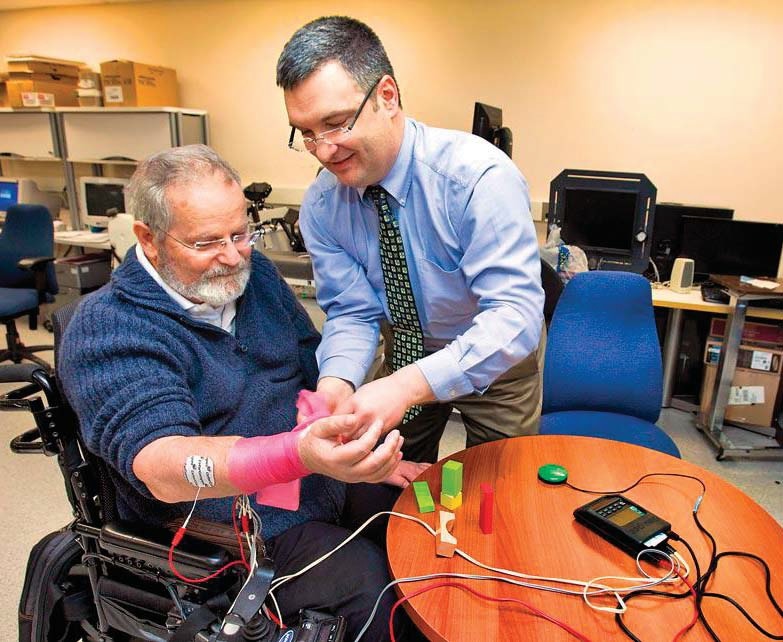
MyndTec was founded in 2008. The purpose of the company is to commercialize functional electrical stimulation therapy which my team and I developed in order to assist paralyzed patients in holding and operating objects. MyndMove therapy, which is its current name, is used to help victims of a stroke or spinal cord injury learn how to reactivate the muscles in their hands. By stimulating muscles, this therapy can reprogram the patient’s brain and teach them to use objects which they were in no state to hold or use after a central nervous system injury.
The electronics which are related to the subcomponents of the MyndMove system were developed by Dr. Alexandar Prodic (Professor, University of Toronto), the students which worked under our guidance, and Dr. Armen Baronijan who received his PhD from the University of Toronto. The actual therapy, method of application, the program which allows for this therapy to reach patients, and the design of the remaining electronic and software systems were developed at the Rehabilitation Engineering Laboratory (www.toronto-fes.ca). Professor Prodic, Dr. Baronija, and I jointly founded the MyndTec in 2008 (www.myndtec.com). Dr. Diana Pliura joined us in 2011, and she heads the company today. She helped us prepare a business plan, attract investors, and commercialize the technology. The MyndMove therapy is found in 19 clinics across Canada, and today, more than 100 patients have been treated. The testimonials of MyndMove patients can be found at www.myndtec.com/success-stories.
SAN: What is the “MyndMove” therapy, and who can it help? How and where are the treatments carried out?
The MyndMove therapy is intended for neurological patients who do not have the ability to intentionally open and close their hand, hold objects, and generally do not have the capacity to use one or both hands in everyday tasks. As long as the patient’s injury is contained to the central nervous system, and not the peripheral nervous system, MyndMove therapy is able to help the patient reprogram their brain and enable them to hold and use various objects once again. After being exposed to the MyndMove therapy, many patients experience a visible improvement in their hand functioning. That does not mean that the patient’s hands will return to the same state they were in before their spinal or brain injury. However, the improvement is dramatic and enables the patient to live independently, and perform the majority of everyday tasks without any help. Additional information about the therapy can be found at www.youtube.com/user/RELToronto and at www.myndtec.com.
SAN: In your prolific, professional career you have received many awards. Which did you find to be the greatest honour and why?
For me personally, the greatest award for our achievements was launching the MyndMove product, and seeing it put to use by therapists, who had never used anything like it, to treat patients who have had strokes more than 15 years ago. The greatest honor was when these patients began to recover and experience unexpected improvements. Personally, that was the greatest award that my team and I received to this very day.
SAN: How do you manage to balance your personal life and your career?
Honestly, I am in no state to be able to adequately balance my personal life and career. I work over 60 hours a week, and this affects my family every day. In life, you can’t “have your cake and eat it too.” Over 20 years ago, I decided that the development of therapies for paralyzed individuals would be my life’s focus. My wife, Kathrin, who is a doctor, decided to support me in this pursuit. Thanks to Kathrin and her encouragement, my team and I were able to create MyndMove and other commercialized technologies whose aim is to assist paralyzed patients.
A Selection of Awards Received by Professor Dr. Miloš R. Popović
1997 – 1st Place Transfer Award from the Swiss National Science Foundation
2008 – Engineering Medal for Research and Development from the Professional Engineers of Ontario and Ontario Society of Professional Engineers
2011 – Elected to the College of Fellows of the American Institute of Medical and Biological Engineering
2012 – MyndTec Inc. won 1st Prize and the Best Intellectual Property Award at the annual TiEQuest Business Venture Competition
2013 – Morris (Mickey) Milner Award for outstanding contributions in the area of Assistive Technologies from the Health Technology Exchange
2013 – University of Toronto Inventor of the Year Award (jointly accepted with a team of colleagues)
2014 – University Health Network’s Inventor of the Year Award
Upcoming Events
Article Categories
- DIARY OF THE IMMIGRANT
- HIGHLIGHTS
- Editor's Note
- Trending
- Interview
- INTERVIEW: COFFEE WITH
- Canada
- Serbian Community
- Serbs Around the World
- Homeland
- Visit Serbia
- Life Today
- History and Traditions
- Through the Prism
- Business & Career & Finances
- New Destinations
- Arts & Culture
- Nurturing Serbian Language
- ABCs of Health
- Our Kitchen
- Diary of a Serbophile
- Sports and Hobbies
- Young Journalists
- Kids’ Page
- Our Youth
Fundraising Campaign for SAN
With your donation, you will contribute to the continued existence of the magazine as well as the maintenance of the website. Your name or company name will be included on our page “Our Sponsors”. If you wish you may also choose to remain anonymous (be sure to select the option to donate anonymously in the application). Thank you for considering to support SAN.
Donate Now