
INTERVIEW WITH BORIS MALAGURSKI "The Truth Can No Longer Be Banned"
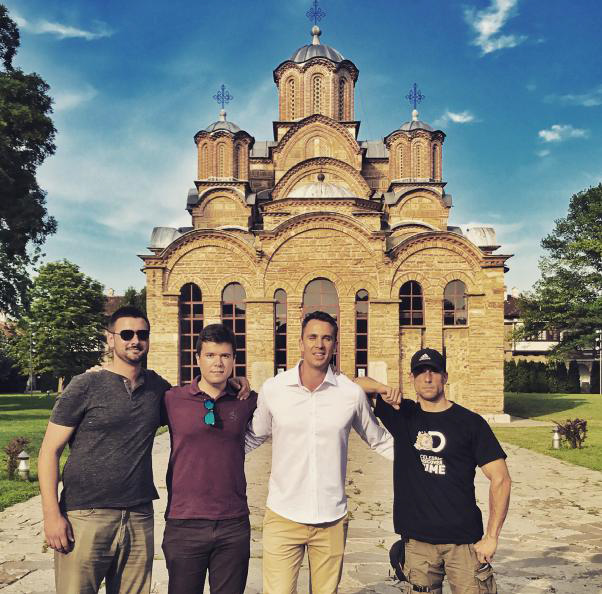
We are chatting with Boris Malagurski, a director, journalist and producer from Belgrade who was educated in Vancouver, and celebrated for his satirical political documentaries"The Weight of Chains" (“Težina Lanaca”)in two parts, which is why he is often referred to in the media as "the Serbian Michael Moore". When we met this year, he was in Toronto to promote his documentary film "Kosovo: A Moment in Civilization". The first commercial for his latest film, "The Weight of Chains 3", has just come out as well.
SAN: What is the theme of your latest documentary film?
Malagurski: It will be the last part of the "Weight of the Chains" trilogy, thus completing the story of the military, economic and biological destruction of our people in the Balkans. By presenting the facts about the bombardment of depleted uranium, which has had a lasting impact on our environment and health, as well as the fact that it is our fault that we do not take sufficient care of ourselves and our environment, I will explain why the time has come to fight against an unjust economic and political system that is set up to only take care of profits, while everything else is neglected.
SAN: Why did the Albanian lobby try to thwart the Toronto premiere of "Kosovo: A Moment in Civilization", despite the fact that the film mainly promotes medieval monasteries to be protected from vandalism?
Malagurski: It is logical that a film that seeks to preserve these monasteries will annoy those who for decades, even centuries, have mercilessly attacked and destroyed them. The so-called "Honourary Consul of the Republic of Kosovo" in Toronto, Chad Rogers, even threatened to report the theatre to the Ontario Human Rights Commission if they screened the movie. However, the theatre had insight into the film, decided it was non-belligerent, and so the film was shown. Our goal was for the world to see the truth about our holy monuments and I think we have succeeded in that. The truth can no longer be banned.
SAN: In the film we saw Serbian cultural heritage testifying to the centuries-old presence of Serbs in Kosovo and Metohija. What impressions do you take away from filming in Kosovo and Metohija (Kosmet for short)? How is it for Serbs living there today, and how is it for Albanians?
Malagurski: Both live poorly. Of course, the Serbs are worse off because they are severely discriminated against in Kosmet, but there is also a sense of dissatisfaction among the Albanians, who are leaving the so-called “Republic of Kosovo” en masse. At one point, Priština had to cancel buses running from Priština to my hometown of Subotica, from where Albanians cross the border and leave for the EU, in a desperate attempt to prevent the exodus. Kosmet is an occupied territory controlled by the United States, and it is increasingly clear that the "Independent Kosovo" project has failed. That is why, now more than ever, it is important for the Serbs to withstand all the pressure.
SAN: The making of this film was preceded by a campaign called #NoKosovoUnesco. What are the results of this engagement?
Malagurski: It was an honour to be a part of that campaign because together with many other organizations and individuals we have proven that when we are united together, we can do great things. Initially, this campaign involved a petition against membership of the so-called "Republic of Kosovo" in UNESCO, as well as lobbying, and the film "Kosovo: A Moment in Civilization" was a logical continuation of the campaign. After the petition and lobbying, Kosovo was not admitted into UNESCO, and when Priština again wanted to apply for membership, via the film we largely prevented them from doing so. This is not my view, but the view of the US Congressional Research Center, whose report stated that my film had an effect so that the so-called "Republic of Kosovo" will not be admitted to UNESCO.
SAN: When will it be possible to see the end of the Kosovo crisis and how will the situation unfold?
Malagurski: I don't think the end of the Kosovo crisis is in sight, because the new injustice cannot correct the old injustice. Our politics must be two-sided: to maximize support for the survival of the Serbs and our holy monuments in Kosovo and Metohija, and also to lobby for our interests in Kosmet in geopolitical circles that have influence in the Balkans. We must correct the first injustice, i.e., abducting Kosmet by violence, to be able to speak of a permanent solution. We should not be discouraged by the seemingly firm support of the Albanian leadership in Priština by the Americans. They supported Saddam Hussein and the Taliban. Everything can change.
SAN: Many consider Kosovo to be the noose around our neck that hinders our integration into the promised European Union, a stable society and economic prosperity, and should be addressed as soon as possible. How do you look at this opinion and argument?
Malagurski: First, Serbia will not get a ticket to join the EU by giving up Kosmet. In 2001, signals were sent to us from the EU that we just needed to deliver Milošević to The Hague and the EU door will open to us. A few years later, they told us that we just had to deliver Radovan Karadžić and then we could enter the EU. And when we did, the "last condition" was to deliver Ratko Mladić. When we did that, stories of a "legally binding agreement with Priština" began. Cyprus was admitted to the EU even though much of the territory was occupied by Turkish forces, and if the EU really wanted to accept Serbia, especiallygiven that not all EU members recognized Kosovo's independence, it would have done so long ago. They admitted Bulgaria, which has terrible problems with corruption and crime. What they present to us from the EU as conditions are actually their excuses. The investments that politicians boast about are a colourful lie– from the state budget money is given to foreign "investors" to pay miserable wages to workers, which posits the slave thesis that "it is better than starving to death". Only the import lobby in Serbia benefits from the EU, which finances the Euro-fanatic politics of every government and the media brainwashing of the citizens who fall for it.
SAN: This summer, a new division shook the Serbian public and social networks. We split into fans for and against the Croatian national team at the FIFA World Cup. How can we overcome these constant divisions that tragically waste energy on such reciprocal friction? What do you think all Serbs could unite around and agree upon to make some progress?
Malagurski: I mentioned media brainwashing a moment ago. On the one hand, you have the placement of fake news, and on the other you have distractions from essential topics. This distraction is best done through the media imposition of topics that polarize the public into those who are “in favour” and those who are “against”. It is almost as if I am saying that I am taking you to a concentration camp, and it is up to you to decide whether you are for Jasenovac or Stara Gradiška. So now you are intensely thinking about what option you should choose and arguing with those who are in favour of the other option, instead of decisively saying all together, "No, we refuseto be taken to a concentration camp!".
SAN: Your TV show "Globally" (“Globalno”), which aired on RTV BN in Republika Srpska, had a huge audience across the region. Captivating through its topical nature and interesting debates, but also through the creativity and gags that make all of your works recognizable. What are your impressions of life in Republika Srpska, do people there have more enthusiasm than in Serbia?
Malagurski: Society in Republika Srpska is livelier than in Serbia. Still, that does not mean people live well there - there are too many who can barely make ends meet. Like in Serbia, many young people are leaving Republika Srpska and seeking a better life in the West. That is why radical changes to the system are needed in all our areas. Patriotism for me does not just mean love for the flag, the coat of arms and the anthem. It is also a love for the domestic economy. Because without a strong economy, there is no quality of life for the people, no strong army to defend those people, no secure future for our children. That is why I would like to see all Serbs in the region agree on changing the system for the better. It will unite us more than anything else.
SAN: Mr. Malagurski, in the present day of media manipulationhow can someone be truthfully informed? How do you inform yourself about events in Serbia and in the world?
Malagurski:The key formula is time. It must take time for that. I know we are all very busy with our jobs, our commitments and our desire for quality free time, but some of that time has to be spent on obtaining quality information. Knowledge is power, or perhaps more precisely - knowledge is freedom. The freedom to make choices for yourself, your environment, and your government based on facts, which is in your interest, and not lies, which is in someone else's interest. Therefore, each topic should be explored from as many sources as possible, and over time you will become aware of what is reliable and what is not. For example, if some news reports say that "Trump will return Kosovo to Serbia", you must read where they got that from. If they write that he said this in an interview with Larry King in 2001, you should investigate whether he really gave an interview back then. You can check onCNN’s website that he did not and that he only talked about Kosovo in 1999 in an interview with Larry King. Then listen to that interview, you will hear that he didn't say anything like that, and you know the news you read is fake. And you will no longer read reports from that media outlet and the individual who wrote the fake news (unless the mistake is unintentional and an apology is offered and a genuine attempt is made to correct the mistake, or rather that the correct news is reported on more intensively). That is how one has to inform themselves. Everything else is based on trust, which can easily be exploited for various manipulations.
SAN: How is it possible to survive as an independent author at a time when the journalistic and film professions have been so abused?
Malagurski: First of all, the way I fund my films is extremely independent. I put a project up on my site and whoever wants to support it can do it, and so from a large number of smaller donations we collect a sufficient budget (all of them are listed on the site, there is complete transparency), instead of asking a single large financier for the entire budget, only then to have the financier require that something of their own be put into the project. That is why I am so disturbing to those in the part of the non-governmental sector in Serbia that receives money for projects through funding by the financiers.
SAN: You are also active on social networks, many like to read your comments on current political events. What are your experiences as an influential social media user?
Malagurski: Social networks are good and bad. On the one hand, they have given us the ability to connect and communicate faster and more than ever in our history, to exchange ideas and plan actions. This is how I and many others use them. On the other hand, they can also pacify us – giving us the illusion that we are doing something, when in realitywe are not doing anything. Everything we do on social networks only makes sense if we do it in the real world too – we must never forget that. Also, social networks have allowed us to surround ourselves with only those thoughts that we already agree with. This is very dangerousbecause people who are engrossed in self-imposed monotony tend to move away from the truth quickly. Over time, such people prefer a pleasant lie rather than an unpleasant truth. It takes sufficient openness and modesty to accept a fact that contradicts our beliefs. When someone convinces us that we are wrong, we should celebrate that person because they have evolved our intellectual life, rather than attacking that person because they are telling us something we don't like. The truth is important, it does not matter whether someone likes that truth or not.
SAN: How have social networks gained so much legitimacy when one tweet can launch diplomatic moves and affect the lives of millions of people? For example, the recent case of the interruption of diplomatic relations between Saudi Arabia and Canada over a tweet of support for a human rights activist in Saudi Arabia written by the Minister of Foreign Affairs of Canada.
Malagurski: In diplomacy, Twitter is just another form of public communication, not much different from a website announcement or a written statement from a diplomatic mission. The difference is that Twitter posts have to be relatively short, so there is more room for misunderstanding.Since you mentioned Saudi Arabia, it’s a great example of how the US story about human rights is empty. In Saudi Arabia, women are the property of men – they are not allowed to make any major decision without men, they are not allowed to compete freely in sports, they are not allowed to interact with unknown men, etc. Opponents of this regime have their heads cut off or they are hung. A gay parade in Riyadh? No chance because homosexuality is punishable by death. In addition, Saudi Arabia is the world's leading financier of Islamic radicalism and terrorism in the world, through the support of Wahhabism, ISIS and other terrorist groups. And what is the first country the new US president visits? Saudi Arabia, USA's greatest friend. Suddenly all human rights stories are irrelevant, all that matters is that oil and money flow. That Canada and Saudi Arabia were quarreling is more of a show for the public. Saudi Arabia is Canada's second largest trading partner in the Middle East. In 2014, Saudi Arabia purchased Canadian weapons worth $15 million Canadian. Weapons with which Saudi Arabia now uses to kill civilians in Yemen, where they created the largest humanitarian catastrophe on the planet. Canada will not downplay its guilt for this kind of diplomatic strife. The country of Canada once advocated for international law and true values. I wish Prime Minister Justin Trudeau had more resemblance to his father, the great statesman Pierre Elliot Trudeau, instead of just trying to be cool, stylish and cute.
SAN: What was it like to study in Canada? What is an achievement of this society that impressed you the most and what did you have a hard time getting used to?
Malagurski: I am connected to Canada by the years I spent there, the wonderful people I hung out with and the films I made while I was studying there. Vancouver is one of the most beautiful cities in the world, and if it weren’t for the rain, it would probably be the best place to live. The system works better than in Serbia. Canadian society, on the other hand, has its drawbacks too - too many people are obsessed with work and money, there is not so much quality socializing (I do not consider drinking on weekends good quality socializing) and being in debt is quite common. I think many in Serbia are not even aware of how valuable it is to own their property. Asalary of a couple of thousand dollars sounds phenomenal in Serbia, but in Canada, that money melts away in a matter of hours because the cost of living is higher. I have met a lot of our people in Canada who dream of returning to our regions, only if the system gets a little tidied up there. My dream is that we really bring the system into order, so that many of our people come back from abroad, to bring with them the knowledge and expertise they have acquired and to create a state of our own together.
SAN: It is unusual for young people to return from here and pursue a career in Serbia like you. How did you decide on something like that?
Malagurski: Honestly, in 2011 I came from Vancouver to Belgrade to shoot a film. I fell in love with a beautiful girl and stayed in Belgrade. I have never once regretted it, although it is not always easy to endure the many absurdities of Serbian everyday life. But it's a nice feeling to be among your own. Maybe I appreciate it more than most because I have lived far from my homeland and I know how hard it is, no matter how much one earns. I had a job in Vancouver while I was studying, but I left it all because I found a higher purpose of living in Serbia. Each of us has a limited amount of time to spend in this world. We can spend that time waiting – waiting for the system to change, waiting for the creation of circumstances so we can do what we desire, waiting for someone to come solve our problems – or we can try to do it all ourselves.
SAN: How did the legendary film "The Weight of Chains" come to be? It is fascinating that at such a young age you realized such a film, and even more so the fact that for the first time on the film screen we see a reconstruction of the foreign factor involvement in the break up of Yugoslavia, and their colonial appetites. How did you manage to get interviews from the many significant figures who appear in the film?
Malagurski: In 2008, I finished a film on human rights in Kosovo and Metohija – it was my first film on Kosmet, "Kosovo: Can You Imagine?". The budget for that film was really small, which reflected in some way on the quality of the film, but it managed to interest some TV networks likeRussia Today (RT). Later, I learned that Vladimir Putin also watched the film and supported the broadcast on RT, which later aired other films of mine, and which I started working on this year. But 10 years ago, I didn't know what my new project was supposed to be. I once went for coffee with one of my buddies, Slobodan Gudelj, and I remember it as if it was yesterday. We were at aStarbucks on Cornwall Street in Vancouver and Sloba told me that there were many films about how Yugoslavia fell apart, but none about why it fell apart. It was actually his idea, not mine. He sent me a bunch of texts and helped me put the idea into action. Another big help came from the Australian continent from Branislav Grbović from Perth, who offered to help with fundraising. Thanks to him, and later others, events were organized to spread the news about the film project, evenings where donations were collected, and so we raised enough money to make this important film. And as for the interviewees in the film – I got to all of them by sending them an email and explaining what my intention was. I think when you do something with your heart, others feel it and are always willing to help.
SAN: Of particular interest are the pieces that testify to those who tried to prevent war, the humanitarianism and humanity that existed on all sides, but which was unpopular in the war-inciting media of the 1990s, and that we never got to see before your film. What are the chances today for young generations in the countries of this region to begood neighbours? Is this possible after more than 25 years of latent tension?
Malagurski: Considering that even just recently Bajaga's appearance in Croatia was banned, it seems to us that since the war, relations have never been worse among the already-quarrelling nations. I would say that the cause of the new wave of chauvinist hysteria imposed by the guardians of the rotten system is the neoliberal economic model that is rapidly decaying. We know the chaos that Agrokor's downfall has caused in Croatia and the region, and both the Republika Srpska and the Federation of B&H are indebted to the IMF, Belgrade officials are obsessed with megalomaniacal projects while the poverty rate in Serbia is over 25 percent, social peace in Montenegro is literally bought with mafia money, and the most interesting example is Macedonia. Macedonians have accepted all the demands of the West in the hope of avoiding ethnically-motivated wars and achieving prosperity. But in 2001 a war broke out with the Albanians, which ended with terrorists gaining state functions (one of the separatist leaders who waged war against the Macedonian army, Talat Xhaferi, later became Macedonia's Defense Minister - now he is Speaker of the Assembly). As for the economy, Macedonia is currently the third poorest country in Europe. All these states are on the verge of complete economic collapse and the only way for the guardians of this rotten system to divert their citizens’ attention away from the catastrophic economic policies they have pursued for decades is to turn the people against each other. That is why we need to talk to those who are aware and not burdened with hatred. It's not always easy, but all other paths lead to constant conflict and war. The occupiers come and go, but the neighbours remain.
SAN: You are only 30 years old and you have achieved so much already. What are your plans, in what direction will your career continue given the brilliant successes in multiple fields, including parody and acting?
Malagurski:I have a bad trait of accepting too many projects at once, so findingtime evenfor sleep becomes a problem. Aside from working on the film "The Weight of Chains 3", I of course continue to make clips for RT and Sputnik Serbia, and when the film is done, I’m planning a new film tour around the world. We'll see what happens after that. I also like to imitate our politicians; they tell me that I can completely “nail” the voice of the president.
SAN: When is the movie "The Weight of Chains 3" expected to be completed?
Malagurski: Hopefully in 2019, but it depends on the budget, which we are currently raising through donations. So, it depends on your readers. If they are willing to support us in presenting the truth to the world about the NATO bombing, GMO food, environmental pollution and a rotten system that threatens human well-being, they can do so by going to our website: weightofchains.ca/three.
SAN: Recently, our magazine was contacted by the organizers of the exhibition to mark the 70th anniversary of the NATO Alliancewhich is being held in Toronto next summer. They asked us to connect them with our people, who would tell their personal stories of "how NATO helped them, defended them and improved their lives", which they would include in their exhibition. As a fighter for the truth and supporter of an argumentative fight, would you engage in dialogue with representatives of such an empire and what would be your approach?
Malagurski: I think Serbs should learn something from the Albanians, Croats and Bosniaks. They are more united than us and they have understood how to lobby in the West. My advice would be for NATO to be overwhelmed with letters and messages from our people about how NATO "helped" us lose control of 15 percent of our territory, as every country "can hardly wait" to be occupied. How NATOhas "helped" us get a cancer epidemic through exposure to depleted uranium, because why be healthy when we can be sick ("Big Pharma likes this")? How NATO "helped" us to be without Milica Rakić, because the children killed were only "collateral damage". How NATO "helped" us get a big hole in the RTS building, because media freedom is totally "out". How NATO "helped" us become economically occupied by the West, because modern slavery is totally "in." And finally, let's send that to the media and give a firm message to NATO– don't “help” us anymore.
SAN: Mr. Malagurski, thank you very much for this interview.
Upcoming Events
Article Categories
- DIARY OF THE IMMIGRANT
- HIGHLIGHTS
- Editor's Note
- Trending
- Interview
- INTERVIEW: COFFEE WITH
- Canada
- Serbian Community
- Serbs Around the World
- Homeland
- Visit Serbia
- Life Today
- History and Traditions
- Through the Prism
- Business & Career & Finances
- New Destinations
- Arts & Culture
- Nurturing Serbian Language
- ABCs of Health
- Our Kitchen
- Diary of a Serbophile
- Sports and Hobbies
- Young Journalists
- Kids’ Page
- Our Youth
Fundraising Campaign for SAN
With your donation, you will contribute to the continued existence of the magazine as well as the maintenance of the website. Your name or company name will be included on our page “Our Sponsors”. If you wish you may also choose to remain anonymous (be sure to select the option to donate anonymously in the application). Thank you for considering to support SAN.
Donate Now