
Interview with Aleks Mihailović
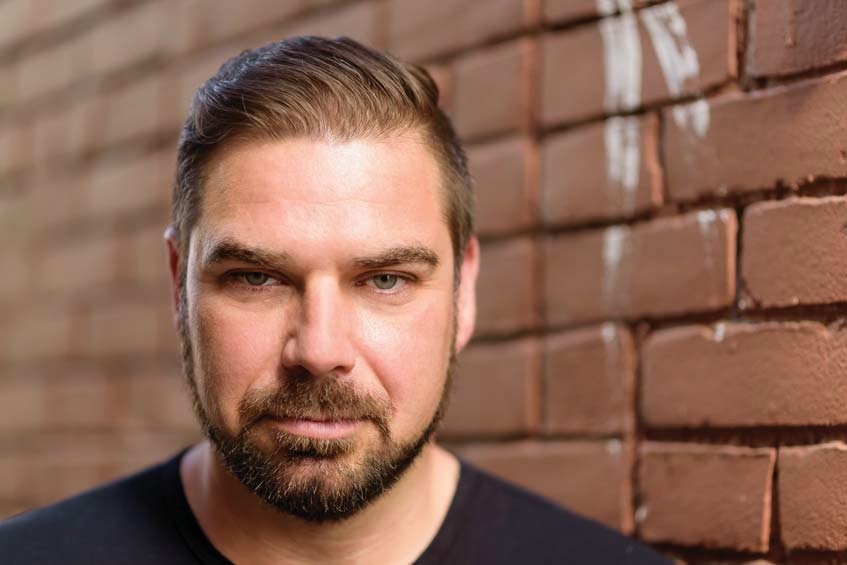
Aleks Mihailović is a Canadian reporter and journalist. He was born and raised in Toronto. He completed a degree in political sciences at the University of Western Ontario, and received a diploma for radio-television broadcasting from Seneca College. Aleks gained his rich journalistic experience by working at RT America, Sun News Network, Global News Toronto, Global TV, CTV Television Network, and CTV Toronto. Before becoming a journalist, Aleks worked for the United Nations in the Balkans.
SAN: Your current career seems to give the impression that you believe that journalists can change the world and that you yourself are a journalist who aspires to do that. When and to what degree do you think that you have influenced a change in attitudes, opinions, and the like?
You must be true to yourself. I have been a journalist for the past 12 years. First, I had to discover how to be a journalist, so I finished my journalism diploma at Seneca College. I honed my craft by working at CTV in Sault Ste. Marie. On a local level, a journalist can take the opportunity to help local citizens, and I believe that I have certainly accomplished that a number of times. I had an even greater impact when I was an anchor at CTV Sudbury. That station covers all of northern Ontario. I was simultaneously an anchor and chief news editor, and had the authority to select the stories that we would present. I was able to express my opinions there. I am not one of those people that think that journalists should not be subjective.
However, I think that people expect journalists to express their own thoughts anyway. I did an interview with Rob Stewart for Global TV, the lead actor of Canada’s “Tropical Heat,” which was very popular in Serbia as well. At the time, that report allowed me to insert a lot of information concerning contemporary events in Serbia and to change the perception of us, at least a little bit. In 2011 I was working for the Sun News Network, who are heavily conservative. I was their analyst for foreign affairs. In that position I was often speaking about matters which people did not want to hear about. For example, Canadians did not like to hear that we, Canadians, were equally at fault for things that were going on in Libya, and that we would be equally at fault if ISIS were to make their presence known there. Concerning Ukraine, my opinion is that the information we have is not correct, that essentially, the revolution and its president did everything which America wanted. The war started in spite of America being given everything it wanted, because it was America that would not allow there to be peace. I also spoke a number of times with Lewis MacKenzie concerning the situation in the former Yugoslavia, and told him that I believed that Karadžić was merely a convenient figure for everyone to focus the blame on.
When I was in Serbia, I observed how the media functions there, and that everything depends on who is showing the news, whether its CNN or RTS. That’s how I first became interested in journalism. I wanted to have on effect on the truth being represented in the media.
SAN: What advice would you give to young people who would like to get involved in journalism?
It is increasingly harder to be in the business. The environment is changing extremely quickly because of the internet. Journalism is not what it once was. Once, it was enough to just go out and objectively give the story, without taking sides. Now it is interesting to tell the story as you experience it, giving your own opinion. Some will like you if you do that, and others will not. I would rather that they hate me than not notice my journalism.
SAN: Between 1994 and 1999 you lived in Serbia and worked for the United Nations in the Balkans. Tell us about life in the Balkans. How much did life in the Balkans enrich your own life and how many frustrations did it pose?
I would never want to exchange the years I spent there. Those were years marked by a weak economy, police presence, and many restrictions. But those were the best years of my life. I was twenty-something years old. I enriched myself by realizing that you could live with much less than you might originally think. And live well, that is. Even when all of those restrictions and sanctions were being enforced, and when there was absolutely nothing, we still enjoyed ourselves, socialized, and had a wonderful time.
SAN: Are there any parallels between the political and economic systems which are found here and the communism and socialism in which we lived under in Yugoslavia and Serbia?
We can put all sorts of labels on the Canadian system, whether its democracy or fascism. But in the end, it is all the same. America does not have a democracy, but an oligarchy. And here in Canada there is also corruption, although it is done a little smarter and without leaving a trace. They know how to hide themselves a little better than they did in Serbia or in the Philippines, where it is done far more openly. The socialism which was prominent in Yugoslavia was highly functional, and that did not sit well with the West. Although whichever way you turn it, the West and its capitalism is getting closer and closer to socialism. That is the natural direction. The most popular countries, countries known primarily for their standards of living, are Canada, Denmark, Switzerland… Actually, nearly all of Europe is socialist. However, socialism cannot operate without capitalism. You need to have capitalism first in order to transition to socialism.
In Russia they resorted to war and forced socialism since they have never had capitalism.
SAN: What are the biggest differences between the Serbian and Canadian mentalities?
Canadians are more tolerant. A big problem with Serbs is the existence of chauvinism and the constant need to be better and more important than others, like that famous story about how we ate with forks in a time when the English were still eating with their fingers. It irritates me extremely that we are so invested in opposing homosexuality. Who cares about what anyone does in their own private bedrooms, why should we be obsessed by this? When I was living in Serbia, I went to a night club with a friend. I noticed that he was staring at someone behind me and he said: “Look, gays! We need to beat them up!” But I just told him: “Have you ever considered that the more gays there are the more women there are for us!” And that was how I stopped him from beating homosexuals up in the club.
SAN: If you had to sum up how to succeed in Canadian society in only a few words, what would you say?
I would say the same thing I would for any other society, be true to yourself and push forward. I was a professor at Centennial College for a time. The first thing that I told my journalism students was that 30 out of a class of 35 would not make it, because their drive and will to succeed were not strong enough. And the five that remain would have to “kick the door down,” and not wait for someone to open it. In Canada, just like Serbia, there was the dream of the seventies that anyone who finished college would have all doors in life opened for them. That dream has dissipated. Finishing college now is the same as finishing high school in the fifties.
SAN: What are your impressions of Serbia in recent years?
Serbia has changed a lot in the last ten years. Belgrade is now a world-class, lively, and interesting city. Sava Mala is something which is really very interesting for artists, and is ranked just below Leipzig. But Novi Sad and Belgrade need to preserve the unique qualities they already possess, instead of always leaning towards newer and more modern trends. A few years ago, Time magazine wrote that Belgrade was the entertainment capital of the world.
SAN: As a final, relevant question, which currently preoccupies the public: how do you think the world will look now that Donald Trump has won the U.S. presidency? What will happen, and will anything change?
The only reason Donald Trump won is because he is not Hillary Clinton. Not only does Clinton represent the status quo in a government which many Americans already view as corrupt, but she had already set a trajectory for engaging Russia, which would have easily led to World War III. Donald Trump is a wild card and a risk which the American voters were willing to take. As we have seen, he withdrew his attention from health care and immigration. He will not be as radical as many people thought, which is apparently a good thing. But regarding the international arena, he has some interesting candidates when it comes to defense and foreign affairs. Those people can take us on a path to peace, or to a much darker place, but for now, it is good that he has said that he will work together with Russia in establishing a more secure world. However, in regards to the environment, I am concerned about his actions.
Upcoming Events
Article Categories
- DIARY OF THE IMMIGRANT
- HIGHLIGHTS
- Editor's Note
- Trending
- Interview
- INTERVIEW: COFFEE WITH
- Canada
- Serbian Community
- Serbs Around the World
- Homeland
- Visit Serbia
- Life Today
- History and Traditions
- Through the Prism
- Business & Career & Finances
- New Destinations
- Arts & Culture
- Nurturing Serbian Language
- ABCs of Health
- Our Kitchen
- Diary of a Serbophile
- Sports and Hobbies
- Young Journalists
- Kids’ Page
- Our Youth
Fundraising Campaign for SAN
With your donation, you will contribute to the continued existence of the magazine as well as the maintenance of the website. Your name or company name will be included on our page “Our Sponsors”. If you wish you may also choose to remain anonymous (be sure to select the option to donate anonymously in the application). Thank you for considering to support SAN.
Donate Now