
No One Knows True Misery Until They Have Crossed Albania on Foot
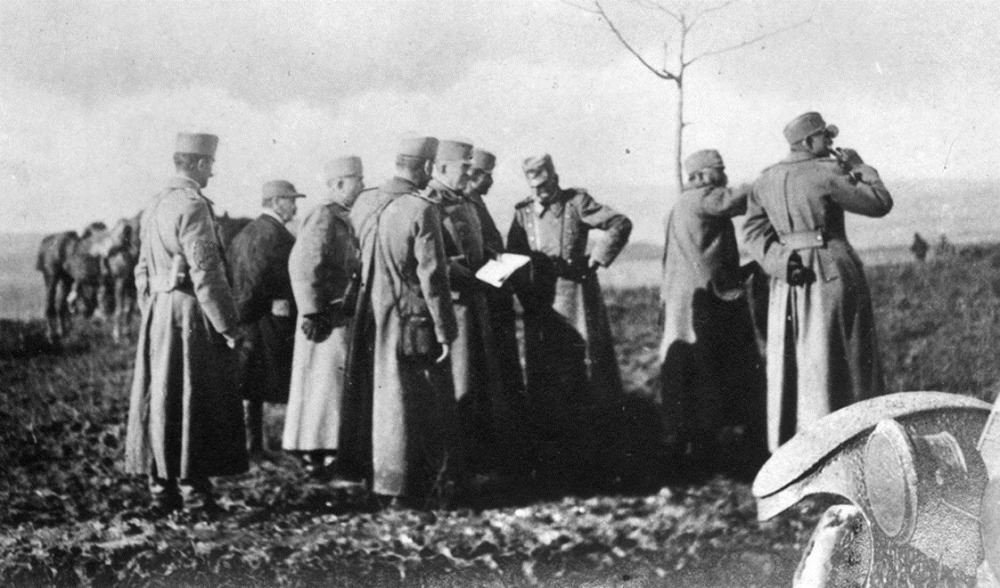
Exactly 100 years ago, on the 25th of November 1915, began the famous retreat of Serbian soldiers and civilians across Albania during World War I. Befalling an entire nation, along with its king, government, military, and clergy, this retreat into exile is one of the most tragic events of our history. 243, 000 lives were lost during the “Albanian Golgotha.”
Where the Yellow Lemon Blooms
Under pressure from the powerful Austro-Hungarian and German offensive, Serbian high command was faced with a choice in the fall of 1915: either capitulate, or retreat through the craggy, snow-covered mountains of Montenegro and Albania. During that retreat, through the entire length of Albania, all the way to the island of Corfu, the Serbs were overcome with horrific losses. Tens of thousands were left trapped in the snow, both soldiers and civilians who were suffering from previous wounds or exhaustion. In regions of Albania outside of Essad Pasha’s control, who had assured safe passage for the Serbian Army, armed skirmishes and attacks were not infrequent.
The fate which befell the people and army was felt just as much by King Peter I, the remaining government of the Kingdom of Serbia, as well as the broader intellectual elite: Dučić, Nušić, Petković Dis, Vinaver, Vojić... Putnik, the Field Marshall who had taken ill, was transported by his solders in a special carrier for the entirety of the Albanian journey. The Serbian army, destroying all its own artillery, spared one mountain battery, carrying it across the “Albanian Golgotha” by hand in order to instill hope.
The First Division of Field Marshall Živojin Mišić was the last to leave in the Serbian Army’s retreat since they had participated with the Montenegrin Army in protecting the right flank. The famous Battle of Mojkovac is proof that the weak can defeat the strong. On Christmas Eve (Badnje Veče) 1916, the Montenegrin army under the command of Sirdar Janko Vukotić exhibited miraculous bravery in its encounter with Austro-Hungarian forces in temperatures which fell below -22 ̊ C. Not only did they stop their most powerful foes in their tracks, but they overcame and repelled them back. There is the famous saying: “If there was not a Božić on Mojkovac, there would be no Easter on Kaymakchalan.”
There were three branches to the Albanian retreat. The Serbian army marched through difficult terrain which had no set path; through snowy blizzards, starving and almost at the limits of physical exhaustion, they died en masse, marking the route of their retreat with a trail of corpses. Heroes from Cera, Drina, and Kolubara had the pall of death, though they still clung to life. There were rumors that some had placed their freezing limbs into the bodies of dead horses in order to survive the sub-zero temperatures and snows that fell throughout the night.
When they laid eyes on the Adriatic Sea at Shkodër and the Port of Shëngjin, the Serbian Army was deeply disappointed. The allied ships which were to receive them were nowhere to be seen. Fearing Austro-Hungarian ships from the Bay of Kotor, the allies had not been able to approach the Port of Shëngjin. The Serbian Army was thus asked to continue its retreat through the marshy Albanian seaside to Durrës and Vlorë. Thus arose new struggles and new casualties! Everyone was approaching their limits of feebleness – they were truly the walking dead. It was thanks to the direct intervention of the Russian Tzar Nicholas II of the Romanovs, that allied ships did arrive and transport the weary sufferers onto the many Greek islands, mostly Corfu. In April, 152, 000 soldiers and civilians arrived at Corfu, with 243, 000 others having succumbed to the “Albanian Golgotha.”
While cauldrons for preparing food were steaming on one side of the island, the first graves were dug on the other, their numbers growing with every passing day. Those whose recovery was hopeless were transported to the island of Vido – “The Island of the Dead.” Every night, barges full of the deceased departed from Vido, travelling 12 miles from Corfu, in order to release their tragic cargo into the open sea between the islands of Kouloura and Divar. It was there that they lowered the Serb soldiers, wreathed in glory, into that “blue tomb.” From the temperate island of Corfu, where the yellow lemon trees bloom three times a year even amidst the wrath of death’s scythe, that Mihailo Zastavniković’s poem “There, far away, where the yellow lemon blooms, that was the Serbian Army’s only path” stems.
After four months of rest and preperation on Corfu, the Serbian Army was taken to the Thessaloniki front where they led some of the first penetrations into occupied territory. These victories initiated the collapse of the Central Powers at the Thessaloniki front, and thus the dissolution of the Great War in, not only the Balkans, but at other fronts as well.
Upon the Army’s departure from Corfu, they left 77 burial mounds scattered across the island which Vladimir Stanimirović describes with the following verses:
“On the foreign mounds, no Serbian flowers will grow,
Tell this to our children, for we will never see them.
Hail the fatherland, kiss the Serbian earth,
Let these mounds remain as monuments of freedom.”
*For more information on these historic events, we recommend the documentary film “Где цвета лимун жут :: Where The Yellow Lemon Blooms,” which can be found on YouTube.
“The Albanian Golgotha – 100 Years Later:” A Mountaineering Expedition
In December 2015, a century after the Albanian retreat, a group of mountaineers has travelled the same route in commemoration of our ancestors and their sacrifices. They traced the original retreat from Kosovo, through the Prokletije mountains and Albania, all the way to Corfu, where their crowning achievement was a climb up Kaymakchalan which lies at the very end of the original march.
This mountaineering expedition, called “The Albanian Golgotha – 100 Years Later,” was completed over the course of two weeks of intensive and exhausting trekking, which spanned over 300 kilometres. Marko Nikolić, the expedition leader, had the following comments: “We were accompanied by good weather. It is true that the temperature went into the negatives at night, but during the day the conditions were sunny and excellent for mountaineering. We followed the same marching route that was taken 100 years ago by the retreating Third Serbian Army. This is the most authentic of three such routes remaining today, that were used by our forefathers’ in their retreat, since it is the only one that has not been asphalted: Peć (Rugovska Gorge) – Čakor – Devojački Krš (2.040 m. above sea-level) – Plav – Gusinje – Vermosh – Selcë – Tamarë – Hoti – Shkodër – Lezhë – Durrës – Corfu.”
The four mountaineers say that they had no problems along the way. They were stopped by border patrol, but only as a formality. Everyone they encountered was extremely polite, and they found aid even among the most reserved locals of Albania’s mountain villages. The mountaineers did not sleep near heavily populated areas, but in tents among remote mountain settlements, or in the doorways of churches. They refrained from lighting fires so as not to disturb the locals. During their marching route, they only used personal items, they melted snow for drinking water, and oriented themselves with the aid of a compass. “Our backpacks weighed 20 kilograms each. We developed blistered and lost weight. We can’t even imagine how it would have been for our forefathers, who wouldn’t have had all of this equipment and who experienced a much harsher winter, since it was difficult for us even at our peak performance and with excellent preparations” – so said Nenad Mitrović, a captain of the Serbian Army and an experienced participant in a number of military navigation competitions.
In Shkodër the group was joined by Stanko Tomić, an American Serb who had set out on the same route, but on a milder route through Rožaje and Podgorica. From here on out, they walked together to Drač, where they continued to Corfu by boat. After their arrival in Corfu, they visited the “Serbian House” and the island of Vido, followed by a trip to Thessaloniki where they visited the Serbian Military Tomb in Zeitenlik. On the border, exhausted, deeply tanned, and bearded from their long time spent on the road, they resembled Syrian refugees, and many people approached them to offer help.
Finally, the members of the expedition climbed to the top of Kaymakchalan (2.521 miles), onto the Nidže mountain which lies on the Macedonian-Greek border. After their recovery at Corfu, the Serbian Army was able to occupy this mountain peak, amidst great losses, repelling the enemy’s line of defense backwards. That was the first victory which followed “Golgotha.” “That was the peak of our journey and its most difficult segment. In one day we covered 54 kilometres throughout the ascent and descent, all of which was through the snow. Kaymakchalan was so difficult and inaccessible that I felt sick, even though I have had climbing experience on peaks which went as high as 5000 metres” – remembers Marko Marković, who instigated and developed the idea for the entire undertaking.
Nemanja Nešković, a professional mountaineer and one of the founders of the extreme sports club “Wild Serbia,” believes that the state of Serbia today and its system of values has changed to such an extent that it appears shameful to love your country, not to mention risking your life for it. “The opportunities in Serbia 100 years ago were few, the government was on the verge of collapsing and disappearing entirely, the people were lost and tired, yet even in those moments they were able to emerge victorious and to fight for their future. Passing through the Albanian mountains, along the same path that our grandfathers died on, is merely a modest gesture in commemorating those people and their contributions. It is an opportunity for us to return to higher ethical values.” The participants of the expedition plan on giving lectures along with presenting photographs and videos that they have recorded. Ultimately, they hope to producing a documentary of their experience.
“Kavala – Corfu” Rowing Expedition
A rowing expedition was organized in the summer of 2015, which drew on the same motives, and whose participants wished to feel at least a small part of the hardships that our forefathers did while travelling during World War I. They were determined to arrive at Corfu by their own manpower, specifically by oar, and they set Kavala as their staring point, a town in the West of Greece.
Jovan Memedović, a famous television journalist and one of the participants of this project, stated the following: “As soon as I found out about the rowing expedition, my participation and contributions were guaranteed. I was one of five group members who alternated rowing duties over the course of 35 days, covering 1200 km. from Kavala to Corfu and the island of Vido, where we ended by kneeling at the “blue tomb.” Reminding myself of our history, I discovered much about human nature, about mental and physical endurance, I discovered much about myself. From time to time, we modern people ought to leave our luxuries and learn to value what we already have, we ought to be content with the comforts that we already enjoy.”
The rowing expedition was not the only journey to Corfu propelled by manpower in 2015. Mark Keating, from Ireland, and his dog accomplished this as well.
“A Walk for Their Lives 1915-2015:” A Pilgrimage
Mark Keating and his Labrador, Paja, set out on a 2000 kilometres long path, raising money for treating children with cancer, while also paying tribute to the lives lost in World War I.
Mark and Paja walked for 4 months, from Belgrade to Corfu and back. Keating called this “A Walk for Their Lives 1915-2015,” and all funds that he gathered were donated for the purchase of special equipment – specifically, Infusomats for the children’s ward of the Oncology and Radiology Clinic in Belgrade.
Mark Keating commented with these inspirational words - “I was inspired to start this fundraiser by two exceptional men in my family. One is my great-grandfather, and the other is the grandfather of my wife, Vesna. Their joint story begins exactly 100 years ago, when they too had to walk long distances for their lives during World War I, fighting on the same side against Bulgarian and Austro-Hungarian forces. Both were extremely lucky to survive. Grandfather Dobroslav Petrović barely made it through the Albanian route, only to be saved in Corfu by a friend who recognized him, dragging him out of a pile of corpses being prepared for burial in the “blue tomb.” After his recovery, he joined the Serbian Army, and participated in the battles at the Thessaloniki front. My great-grandfather, Thomas Frederick Vaughan, was also there as part of the Irish battalion. That happened 100 years ago, and I wanted to do something to mark this anniversary. I can’t compare my own walk with the struggles of a sick child. But, the will to live possessed by our ancestors as well as these exceptional children, battling mortal illnesses, inspired me to set out on this path. I try to summon their energy, whenever I am faced with difficulties.”
Upcoming Events
Article Categories
- DIARY OF THE IMMIGRANT
- HIGHLIGHTS
- Editor's Note
- Trending
- Interview
- INTERVIEW: COFFEE WITH
- Canada
- Serbian Community
- Serbs Around the World
- Homeland
- Visit Serbia
- Life Today
- History and Traditions
- Through the Prism
- Business & Career & Finances
- New Destinations
- Arts & Culture
- Nurturing Serbian Language
- ABCs of Health
- Our Kitchen
- Diary of a Serbophile
- Sports and Hobbies
- Young Journalists
- Kids’ Page
- Our Youth
Fundraising Campaign for SAN
With your donation, you will contribute to the continued existence of the magazine as well as the maintenance of the website. Your name or company name will be included on our page “Our Sponsors”. If you wish you may also choose to remain anonymous (be sure to select the option to donate anonymously in the application). Thank you for considering to support SAN.
Donate Now