
A HISTORICAL NOTE FROM THE PRAIRIES: HEAD-SMASHED-IN BUFFALO JUMP
Everyone has long known the humorous catchphrase, "Ladno, al’ standard". Indeed, it is easy for us here in the northern part of the North American continent to endure the long winters as California strawberries await us in the supermarkets in mid-January.
However, did you know that these places were even inhabited by humans 10,000 years ago? How did they handle the arrival of winter and the snow blowing across the prairies?
Head-Smashed-In Buffalo Jump is a historic UNESCO-protected site. It is located in Alberta, 184 kilometers south of Calgary and 18 kilometers west of Fort MacLeod. This site was traditionally inhabited by the tribes of the Blackfoot Confederacy, and archaeological evidence indicates that the site was used by North American Indians for hunting and ceremonies over 6,000 years ago.
In ancient times, the survival of Native American tribes in the prairies depended heavily on the successful bison hunt. Bison leather and fur were used to make clothing and tents (tipis), meat and offal for food, and bones for tools and weapons.
When I first heard about this place, in my ignorance, and certainly under the influence of cowboy films, I created an image of Native Americans on horseback, armed with Winchester rifles, summoning terrified bison toward the cliff from which they fall to certain death.Why did they chase them at all when they could have shot them, which would have been easier? A thought that overlooks the fact that the prairie Indians hunted bison at a time when there were no firearms, at a time before they tamed wild horses, and at a time about 6,000 years before European settlers set foot in these parts. Imagine now a bison, horned bovine, about 1.8 metres tall, up to three metres long, weighing between 500 and 1,000 kilograms, which, in order to survive the winter, you would have to catch practically barehanded.
Native American tribes lived in harmony with nature and learned from it by observing and analyzing the world around them. By using an excellent knowledge of the topography, along with knowing the behaviour and habits of the prairie bison, Blackfoot hunters developed a complex plan to get the whole herd of bison to rush to the cliffwhere they would all fall to their deaths, while another group of hunters would await them at the foot of the cliff. Their task then was to separate the buffalo skins, cut the flesh and clean the bones before wolves, bears and other prairie predators were attracted by the smell of blood. Head-Smashed-In Buffalo Jump is an outstanding example of hunting techniques that were usedup until the 19th century and illustrates perfectly the way of life and survival on the prairies in the past.
If you visit this historic site, Blackfoot guides, descendants of ancient warriors and hunters, will tell you stories of how their ancestors hunted powerful bison. You will also be able to watch a short documentary film detailing this brave and dangerous way of hunting. Within the museum space are displays that tell the history of the tribes that made up the Blackfoot Confederacy. You will learn that the prairie Indians had winter and summer camps, that in the middle of the summer the tribes met to attend a ceremony called Sun Dance, after which they separated again and slowly prepared for the fall and a new bison hunt, which would allow them to endure the long and cold prairie winters – only if it is a successful hunt.
And so, thousands of years later, for settlers and Indigenous peoples alike, it's easy to stock up for winter in crowded mega-markets, but stories of times past and ancient customs remind us that nature is important and that we have to get to know it, respect it and live in harmony with it.
Head-Smashed-In Buffalo Jump –The cliff from which a herd of bison would stampede off of toward their death
Source:https://whc.unesco.org/en/documents/119572
Head-Smashed-In Buffalo Jump –Museum in the foothills
Source: Ken Thomas - KenThomas.us(personal website of photographer), Public Domain, https://commons.wikimedia.org/w/index.php?curid=3601365
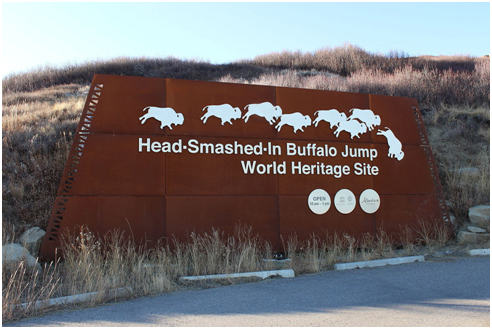
Sign at the entrance to the museum
Source: Lazarus000 - Own work, CC BY-SA 4.0, https://commons.wikimedia.org/w/index.php?curid=45659978
Prairie bison
Source: Jack Dykinga [Public domain], via Wikimedia Commons
https://upload.wikimedia.org/wikipedia/commons/8/8d/American_bison_k5680-1.jpg

Upcoming Events
Article Categories
- DIARY OF THE IMMIGRANT
- HIGHLIGHTS
- Editor's Note
- Trending
- Interview
- INTERVIEW: COFFEE WITH
- Canada
- Serbian Community
- Serbs Around the World
- Homeland
- Visit Serbia
- Life Today
- History and Traditions
- Through the Prism
- Business & Career & Finances
- New Destinations
- Arts & Culture
- Nurturing Serbian Language
- ABCs of Health
- Our Kitchen
- Diary of a Serbophile
- Sports and Hobbies
- Young Journalists
- Kids’ Page
- Our Youth
Fundraising Campaign for SAN
With your donation, you will contribute to the continued existence of the magazine as well as the maintenance of the website. Your name or company name will be included on our page “Our Sponsors”. If you wish you may also choose to remain anonymous (be sure to select the option to donate anonymously in the application). Thank you for considering to support SAN.
Donate Now