
Noble titles
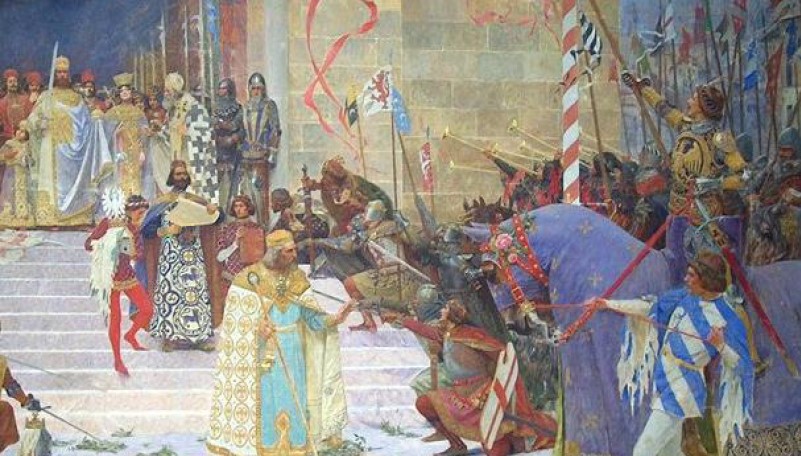
When learning about history, people often come across various titles of nobility, but many do not quite understand them. I'm sure you once wondered what a prince compared to a duke is, what a prefect, a viceroy, and so on represent. If you are interested, I will try to clarify Serbian noble titles. They are ordered from the highest to the lowest, although some titles gained more or less prestige in various periods, so it is impossible to present that hierarchy perfectly. In the end, I will present separately the titles introduced by Emperor Dušan.
Titles before Dušan
The emperor
Unlike the king, the emperor refers to the legitimacy of the Roman Empire. In the Middle Ages, the title meant the heir of Rome or a foreign ruler equal to the Roman emperor (like the emperor of China). Later on, the title became wider and was also used by those who ruled over several kings, such as the German Kaiser. Western European emperors associate themselves with the Frankish ruler Charlemagne, who was proclaimed by the Pope as the heir of Rome. Eastern European emperors refer to Byzantium, that is, the Greek part of the Roman Empire that survived the fall of Rome. There are two Roman imperial titles – Augustus (august), which is translated into Greek as sebastos or basileus, that title belongs only to the Roman emperor. Another title in the eastern part of the empire is Caesar, in Greek autokrator, which was also given to a co-ruler, a lower emperor. The Bulgarians used the title emperor in the sense of Caesar and viewed the Byzantine emperor as Augustus. The Serbian king Constantine Bodin (from the Vojislavljević dynasty) was invited before the succession of Serbia to assume the title of Emperor of Bulgaria under the name Petar II, but he failed to keep it. He is the only Serbian emperor before Dušan.
The King
The king is a sovereign monarch of the highest rank who doesn’t refer to Roman succession. The Slavic word king comes from the name Karl after Charlemagne, the Frankish conqueror and Holy Roman Emperor.
The Grand Duke and the Grand Prefect
Grand dukes and grand prefects are the rulers of Serbia who didn’t take the royal title. Most Serbian monarchs were grand prefects or grand dukes. They are the rulers of a principality or county to which other princes or counties are subjects. The Russian title prince was used in modern times in the same way to distinguish Miloš Obrenović from lower Serbian princes.
The Prince (knez)
The prince (knez) is a title equal to a prince, but not to the heir to the throne. Prince is a title for a ruler below a king who holds a large region. A sovereign prince, knez in Serbian, is a ruler without a king above him, who nevertheless does not have the same status as kings. He differs from the great princes in that he has no other princes under him. Prince of Wales is a princely title given to the English heir to the throne after the conquest of an independent principality. Such princes are called "crown princes" in English to distinguish them from sovereign princes. In different countries, the heirs to the throne have various titles below the ruler, for example Grand Duke of Austria. The prince (knez) and prefect were translated into Greek as archon. The prince (knez) is an old Slavic title for a chief. After the Ottoman period, the status of the title decreased and there were many princes in Serbia.
The Prefect
The Prefect is the title of some Slavic chiefs, which took on great importance in the early Middle Ages. It is believed that it comes from the Persian word chopan, from which shepherd originates, and that it means figuratively shepherd of people, not flocks. The early Slavs lived close to the Scythians, nomads who spoke a language similar to Persian and exchanged culture and expressions with them. In the early Middle Ages, prefect and prince were equal titles. However, already under the Vojislavljević dynasty in the 10th century, minor rulers within the Principality of Duklja also had the title of prefect, so they are seen as equal to a count.
Despot
The title despot was not used by Serbs before Dušan, but the Byzantines gave it to Serbian rulers who helped them. It literally means ruler.
Viceroy (ban)
Viceroy (ban) is a Slavonic title popular in countries under Hungarian influence. It means a noble who rules the border regions of the state and has greater autonomy. The Greeks compare it with the title of exarch (administrator of the territory on the border), although exarch is not a hereditary title. Viceroy is equal to the French Marquis or the German Markgraf. It is believed that this title originates from the Persian title Bey which means lord (god) or from the Avar name Bayan (from which our name Bojan comes) which means ruler.
The duke
The duke was originally a military leader of a Slavic tribe and the title retained that status as noble leading armies, but in the administrative sense it began to mean a lower noble as well. It is equal to the titles dux (LAT), duke (EN), duc (FRA) and herzog (NjE), which do not carry military connotations. The title duke can be given to a commander-in-chief in a military context and compared to a marshal, but beyond that duke is equal to the meaning of the word duke. It is sometimes translated into Latin as bellidux, which means war dux. Under the Nemanjić dinasty, duke was the highest title at court.
Tepčija
Tepčija oversees the personal possessions of the Serbian king. It is the highest administrative title at the Serbian court. It first appeared, like other court titles, at the time of the dynasty Nemanjić, in the middle of the Middle Ages. Until then, the Serbian court and most European courts were not developed, so most of the titles were related to owning land and leading the army, and not to organizing the court and inter-noble relations.
Kaznac
Kaznac is the finance minister who levies fines for crimes and oversees the collection of taxes. The Western title chamberlain combines the functions of tepčija and kaznac.
Čelnik
Čelnik is a title used among the Nemanjić dinasty. It comes from the word čelo (forehead) because the leader is at the head of the Serbian nobility, although there were once many more prestigious and higher titles. Čelnik is similar to the titles kafala (head) in Byzantium, count palace (comes palatinus) in the west or grand duke in Bosnia. Čelnik was charged with protecting the property of the nobles and the church and served as a judge in disputes between nobles. In addition, he generally saw to it that the king's orders were carried out. There could be several of them at once, but not too many.
Stavilac
Stavilac (literally “placer”) set the table for the Serbian king and organized meals and feasts. Like many court titles, this would sound like an insult in today's times for a great nobleman to be a servant, but it is actually a prestigious title. At the English court, such serving nobles would be called grooms, and in French, valets. They had various functions, from the groom of the chamber, who prepares the king's room, to the groom of the stool, who wipes his buttocks and analyzes the state of excrement after defecating for the sake of the king's health. Although they did humiliating jobs, these great nobles had access to the king when no one else did and were his closest friends, advisers and confidants. Organizing the king's meals meant that you were next to him when he ate and that you could talk to him, determine who could approach him and respect or honor the nobles by spending time at the table. This gave great power to Stavilac.
Servant
A servant derives from the Byzantine title domestikos and resembles either the French valets or a page (a young knight who teaches modesty). Servant is a title that Stefan Dečanski lists among the nobles who attended the founding of Visoki Dečani. From this, one could perhaps conclude that, unlike the Byzantine domestikos, they were not eunuchs (castrated court administrators), but lower nobles outside the great court hierarchy.
Ostrok
Ostroks are assistants of tepčija, that is, lower administrators of the royal estates, and they mainly fulfilled financial and inspection tasks on behalf of tepčija.
Titles at Dušan's court
Emperor Dušan mostly kept the Serbian titles from before and the adopted Byzantine titles of his ancestors. As part of his assumption of the title of Byzantine emperor, Dušan introduced more Greek titles to his court and Hellenized some existing Serbian ones. He replaced the title of prefect, which at that time was equal to count, with a kephale. The hierarchy under Dušan, from the bottom to the top, looked like this: village and city administrator, kephale, krajišnik, despot, then followed by court titles such as ostrok, logotet, servant, cupbearer, chamberlain, stavilac, čelnik, kaznac, protovestiarios, duke and kesar.
Older court titles such as čelnik, servant, and kaznac received sub-variants, most likely because the court itself expanded. For example, there is a small čelnik, čelnik and big čelenik.
Below I will list only new titles or titles with new meanings.
Emperor (basileus)
The title of the Serbian ruler who saw himself as the heir of Rome.
Kesar
Serbian translation of the title Caesar, used for a lower co-ruler.
Protovestiarios
The protovestiarios kept the emperor's clothes and supervised the dressing of the emperor and served as a financial adviser. In Byzantium, the protovestiarios were originally eunuchs, but even before the Serbian takeover of the title, the Byzantines also gave it to uncastrated courtiers.
Despot
Despot is a Byzantine administrative title that the Serbs continued to use. The title is sometimes equal to a count, and sometimes to a prince, and is not always hereditary. Emperor Dušan's half-brother, Simeon Siniša, received the prestigious title of Despotate of Epirus, and many Serbian nobles received other despotisms. When, after Dušan's death, Simeon proclaimed himself emperor instead of Uroš (Dušan's son), he gave the title of despot to some of his allies, among them Albanian chieftains. Serbia was reduced to the status of despotism after the Ottoman attacks.
Krajišnik
A lower administrator, the ruler of a region or border, a smaller region within a Despotate or Principality.
Chamberlain
The chamberlain is the Valet de Chambre, he works around the emperor's "chamber", that is, the room.
Cupbearer
The cupbearer pours the emperor's drink during feasts. There is a possibility that the cupbearers tested the emperor's drink to make sure it was not poisoned and may have played a role in the administration of the court.
Logotet
The logotet is a treasurer.
Upcoming Events
Article Categories
- DIARY OF THE IMMIGRANT
- HIGHLIGHTS
- Editor's Note
- Trending
- Interview
- INTERVIEW: COFFEE WITH
- Canada
- Serbian Community
- Serbs Around the World
- Homeland
- Visit Serbia
- Life Today
- History and Traditions
- Through the Prism
- Business & Career & Finances
- New Destinations
- Arts & Culture
- Nurturing Serbian Language
- ABCs of Health
- Our Kitchen
- Diary of a Serbophile
- Sports and Hobbies
- Young Journalists
- Kids’ Page
- Our Youth
Fundraising Campaign for SAN
With your donation, you will contribute to the continued existence of the magazine as well as the maintenance of the website. Your name or company name will be included on our page “Our Sponsors”. If you wish you may also choose to remain anonymous (be sure to select the option to donate anonymously in the application). Thank you for considering to support SAN.
Donate Now