
MANASIJA – THEN AND NOW
 |
 |
Of all the ancient professions, historians must certainly appreciate scribes the most. Before the printing press was invented, monasteries were the places where noble scholars helped preserve our past by studying, copying and
translating Greek and Roman classics. Thanks to their dedicated work we are able to appreciate what survived of the literature, art and scholarship of antiquity, which in turn allows us to better understand our path from then to now. It was with this in mind that I found myself reverently examining the ruins of the School of Resava inside the timeless walls of Manasija.
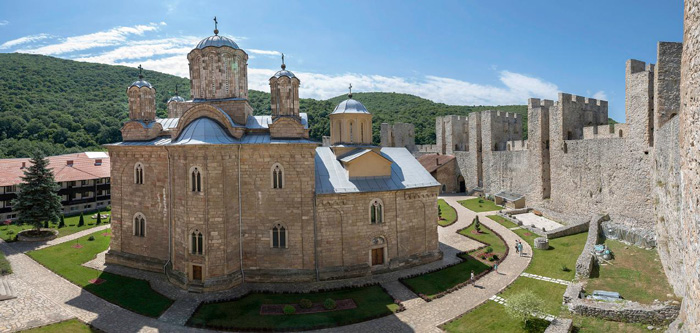
The spectacular last gasp of medieval Serbian cultural expression is nestled in a valley amongst luxurious, green hills and utter tranquility. Formerly named after the Resava river that runs in every cardinal direction before circumventing the high walls of the bastion, no one can say how or why it came to be known as Manasija. The fortress structure reveals the arrival of the cannonball in medieval warfare, with earlier square towers connected to later deflective hexagons.
These imposing defences guard the Church of the Holy Trinity, restored to near perfection in the 19th century. It shelters the most beautiful frescoes in Serbia as well as a unique mosaic floor unseen in any other monastery. But what captivates my mind is imagining the activities of the scribes in the School, whose walls were, prior to its destruction, adorned with frescoes and lined with books.
In the 15th century, they housed Despot Lazarević’s library of some 20,000 volumes. It was Serbia’s Alexandria.
This was where scholars fleeing the approaching Turks gathered to read, write, and continue the work of copying and translating, safeguarding the treasures of the past. The school was a shrine to the work done within its walls, honoured with the preservation of the Serbian language through the work of Constantine the Philosopher. This remarkable man also corrected the mistranslations of classics by the less meticulous, and his legacy continued for another two centuries under the Ottomans. I often think how magical it would be to travel back in time and
peruse the collection that was preserved there, but then I would have to learn Greek and Old Slavic!
It was also at Manasija in 1790 that, according to the Military Archives in Vienna, the occupying Turks invited a couple of hundred Serbian worshippers to pray at the defunct church, only to slaughter all of them. As such, the
site was sanctified and, similarly to Ćele Kula, added fuel to the fires of the coming Uprisings. But there is no hint of tragedy today, and the lovingly maintained cloister is shared by nuns, restoration workers and fascinated visitors. It
is without a doubt one of the most beautiful locations in Europe, and every photo taken from within or without becomes an instant postcard.
For my own part, my twin loves of history and Serbia coincide at this unique spot to make my visits a serbophile›s pilgrimage to a sanctum of knowledge. A day trip to Manasija provides a perfect escape from the summer heat of Belgrade. A two hour drive leads not only to more medieval beauty than eyes can behold, but to nearby Resavska
Pećina, a spectacularly intact stalactite cave.
The day can be completed in the vicinity with a visit to the Veliki Buk gorge and waterfall, also known as Lisine, and then capped with a meal at the charming Vodopad resto at the base. You’ll be left with indelible impressions of the most enchanting kind.
Upcoming Events
Article Categories
- DIARY OF THE IMMIGRANT
- HIGHLIGHTS
- Editor's Note
- Trending
- Interview
- INTERVIEW: COFFEE WITH
- Canada
- Serbian Community
- Serbs Around the World
- Homeland
- Visit Serbia
- Life Today
- History and Traditions
- Through the Prism
- Business & Career & Finances
- New Destinations
- Arts & Culture
- Nurturing Serbian Language
- ABCs of Health
- Our Kitchen
- Diary of a Serbophile
- Sports and Hobbies
- Young Journalists
- Kids’ Page
- Our Youth
Fundraising Campaign for SAN
With your donation, you will contribute to the continued existence of the magazine as well as the maintenance of the website. Your name or company name will be included on our page “Our Sponsors”. If you wish you may also choose to remain anonymous (be sure to select the option to donate anonymously in the application). Thank you for considering to support SAN.
Donate Now