
Interview with Kati Csaba Canada’s Ambassador to Serbia, Montenegro and North Macedonia
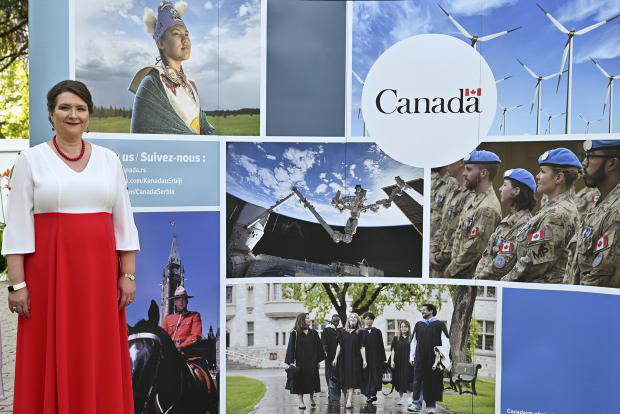
I met Ms. Kati Csaba, Canada’s Ambassador to Serbia, Montenegro and North Macedonia, in Toronto at the celebration of Statehood Day of the Republic of Serbia in March 2019. After exchanging just a few pleasantries, I felt a great closeness to her. The conversation went smoothly and I was delighted with her openness, plainspokenness and good knowledge of the Serbian language. It felt to me like we had always known each other. We exchanged business cards and immediately agreed to do an interview together for SAN Magazine one day. My acquaintance with Ms. Kati Csaba once again confirmed what I have always known, and that is that there is no success without a lot of hard work and effort. Kati Csaba’s rich diplomatic career took her from Canada through Budapest, Kiev, Sarajevo, Moscow, Addis Ababa and then to Belgrade, where she now lives with her husband and two teenage children.
SAN: What influenced you in deciding to study Political Science and the Russian language, as well as, Central/Eastern European and Russian Studies? How did you develop an interest and love for diplomacy?
Kati: It is hard to remember now what exactly drew me to diplomacy, but as far back as high school I had this idea that diplomacy would be an interesting life. I always loved to travel and explore new cultures, so diplomacy seemed like a way to achieve that goal and get paid for doing so! I started studying political science and particularly international relations in university as the best way to work towards that goal. I already spoke French and had studied Spanish and German in high school, so I decided to take Russian as another language that could be useful in diplomacy, and found that I loved the language and became very interested in Slavic history and culture. This then prompted me to focus my Master’s studies on what was then called Soviet and East European studies. Learning about this part of the world put me on a very interesting career path, as I have spent much of my professional life working on or in this region, including five of my six postings abroad.
SAN: It’s known that diplomatic life is not easy and requires a lot of sacrifices and family support. Did you have any problems adjusting to life in Serbia? What are the biggest challenges of diplomatic life for your family, and especially your children? How did your family adjust to living in Belgrade?
Kati: Some people believe that diplomats spend all their time at glamorous cocktail parties, and while we do enjoy the privilege of attending cultural and networking events to learn more about the countries with whom Canada shares a relationship, the truth is that diplomacy is quite a demanding career path. We pack up and move to a new country every few years, requiring the whole family to start from scratch in making friends and adjusting to a new life. We spend long hours in the office, followed by a variety of receptions and cultural events in the evenings. Some of these can be fun, but they are mostly about work: to show our respect for the country or organisation hosting the event and support their activities, and as an efficient way of meeting up with key contacts in a short space of time to discuss important issues. These long hours mean that I missed a lot of family suppers and time with my family, although I tried to make up for that in other ways. Fortunately, my family and I all found it quite easy to adjust to life in Belgrade and we have really enjoyed ourselves here. Belgrade offers a rich cultural life, interesting touristic sites to visit, and great restaurants and cafés, so there is something for everyone’s taste.
SAN: You became the Ambassador of Canada to Serbia and Montenegro in December 2017, and the Ambassador of Canada to North Macedonia in January 2018. What are the most important initiatives, changes, and notable achievements in these countries since 2017? What are the most important plans for the future?
Kati: Canada enjoys positive and dynamic bilateral relations with all three countries of our accreditation. Although we are not a member, we strongly support full-fledged EU integrations of Serbia, Montenegro and North Macedonia, as the best way to secure regional stability, security and prosperity. We were very glad to welcome the latest newcomers to NATO Alliance, Montenegro and North Macedonia, who already proved to be valuable partners in the Alliance. We are continuously encouraging continued democratic reforms, good governance, strengthening the rule of law, promoting respect for human and minority rights, gender equality and media freedom. There are many examples of activities and initiatives undertaken by the Embassy to promote Canadian values and priorities. Media freedom, for example, remains a serious concern in the region. To help highlight the problem and support a dialogue on potential remedies, Canada and the UK co-hosted Global Conference for Media Freedom in London last July, and the Embassy organized, together with our partners from the UK Embassy in Belgrade, additional consultations with key local stakeholders, both before and after the Conference in London. Most recent example of various activities and initiatives is Canadian contribution, through the Red Cross, in responding to the consequences of June 22-24 flooding in Serbia, by provisioning safe drinking water, food and hygiene in 20 affected municipalities. Canada also donated $250,000 to Montenegro and North Macedonia each as the assistance in fighting the Covid-19 pandemic. Through our Canada Fund for Local Initiatives, the Embassy supports projects of civil society organizations and NGOs in all three countries of our accreditation on annual basis, with focus on gender equality, empowerment of women and girls, peace and security and inclusive governance and the rule of law.
SAN: What do you think about Serbs? Do we fit the stereotype that circulates about us, or did you change your opinion about us once you came to Serbia and had the opportunity to get to know us? How similar are we in mentality to Montenegrins and Macedonians?
Since my arrival in Belgrade in 2017, I have met and gotten to know many wonderful people in Serbia, Montenegro and North Macedonia. I have been impressed by the warmth and friendliness of people in the communities I have visited, and have felt very welcome here. Since it is a part of my work to be able to adapt to new cultural contexts, and as a person with a multicultural background myself, I try very hard not to think in terms of national, ethnic, religious or other stereotypes. Instead, I focus on the issues that bring us together, like caring for our families and the less fortunate, strengthening communities, promoting human rights, and protecting the environment. The coronavirus crisis has served to emphasise how we all benefit when we work together.
SAN: Can you tell us a bit more about the possibility of getting a student visa in Canada. Does Canada have summer jobs programs for students? Does Canada have skilled worker exchange programs? And do experts from Serbia, Montenegro and Macedonia come to Canada?
Kati: Canada, as a country recognized for its high-quality education system, offers an array of endless possibilities for international students to find the program of study that’s right for them: possibilities for theoretical and practical learning, possibilities to put what’s been learned into action, and possibilities to stay and work, making the dream of a successful career a tangible reality. Foreign students can stay and work in Canada during the summer break, except that this opportunity is, unfortunately, less available this year due to the already known situation with the COVID-19 pandemic. All information on studying in Canada, scholarships and the procedure for obtaining a student visa can be found on the EduCanada website. We are proud of the large number of foreign experts who have chosen to continue their postgraduate studies at Canadian universities and research institutes, including experts from Serbia, North Macedonia and Montenegro. Canadian university professors and experts give lectures and participate at international conferences around the world, including the ones in this region. I would especially like to point out an international network of professors who teach Canadian studies worldwide. The Serbian Association for Canadian Studies (SACS) regularly organizes international conferences and seminars on diverse themes related to Canada and its values.
SAN: Cooperation between Canada and Serbia has improved significantly in the last ten years. To what extent is the Serbian market attractive for Canadian capital investment? Which industry is the most invested in? What problems do Canadian companies investing in Serbia face and what is being done to overcome these problems?
Kati: Trade and investment level between Canada and Serbia have been significantly improved during the past 10 years, thanks to attractiveness of specific sectors of the Serbian economy, as well as Canadian companies’ strategies to invest their capital in the emerging markets with solid potentials. Trade between Canada and Serbia today amounts CAD100 million, with two-way growth recorded every year. It tells us that companies from both countries have quality goods and services to offer on markets of both Canada and Serbia and our Embassy, through Trade Commissioner Service of the Global Affairs Canada offers full support to these trends, through cooperation with private sectors and institutions in both countries. In the past 10 years, Canadian companies have been mostly known for their investments in the mining sector in Serbia and development of many projects, including the now globally renowned copper-gold project “Čukaru Peki”, once developed by Vancouver-based company “Nevsun Resources”. We hope to witness opening of a Canadian mine in Serbia in the forthcoming years. On the other hand, sectors of clean technologies and environment protection presents strong potential for cooperation between Canada and Serbia. Serbia, as well as unfortunately entire region of the Western Balkan faces many different issues in environment protection, including air pollution. Canada is recognized as one of the global leaders in the development of the products and services in the environment protection, in line with its status of the Paris Agreement signee. Companies from Canada already actively discuss their business presence in Serbia and the entire region and we hope to get Canada’s excellence in this sector closer to local market and establish cooperation to mutual satisfaction. Let me invite all the companies from Canada, including from sectors of mining, clean technologies, construction, agriculture and ICT to contact our Trade Commissioner Service in case they are interested in exploring market potentials and opportunities in the market of Serbia and the entire region of the Western Balkan.
SAN: What compromises did you have to make as a woman and mother because of your career? What advice can you give to young people who want to pursue a career in diplomacy?
Kati: Every person has to decide on what compromises they are prepared to make to advance their career and support their family. As a feminist, I believe strongly in gender equality and the empowerment of women and girls, so this has guided my thinking throughout my career. I have worked hard for my success, and am fortunate to have been supported by my husband and two children throughout. When our children were young, I tried to limit my overtime and travel as much as possible so that I could spend more time at home with them. Now that they are older, I am much busier with work, but we still find ways to spend time together. This life would have been difficult without my husband at my side. He has been a real partner, taking on all kinds of responsibilities at home, like caring for the children and doing most of the cooking during certain periods. My advice for young people interested in diplomacy is to go into it with your eyes open, knowing that it can be a challenging and stressful life, while also a very satisfying career that allows you to engage in global issues that affect all of us.
Upcoming Events
Article Categories
- DIARY OF THE IMMIGRANT
- HIGHLIGHTS
- Editor's Note
- Trending
- Interview
- INTERVIEW: COFFEE WITH
- Canada
- Serbian Community
- Serbs Around the World
- Homeland
- Visit Serbia
- Life Today
- History and Traditions
- Through the Prism
- Business & Career & Finances
- New Destinations
- Arts & Culture
- Nurturing Serbian Language
- ABCs of Health
- Our Kitchen
- Diary of a Serbophile
- Sports and Hobbies
- Young Journalists
- Kids’ Page
- Our Youth
Fundraising Campaign for SAN
With your donation, you will contribute to the continued existence of the magazine as well as the maintenance of the website. Your name or company name will be included on our page “Our Sponsors”. If you wish you may also choose to remain anonymous (be sure to select the option to donate anonymously in the application). Thank you for considering to support SAN.
Donate Now